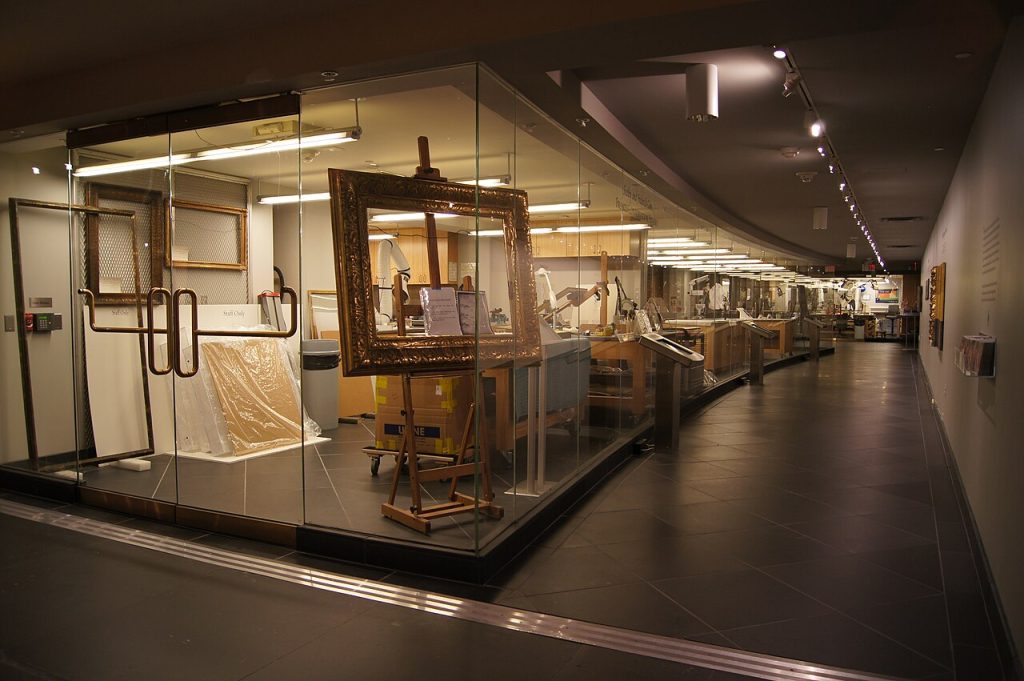
Most museums keep their secrets behind locked doors. The Smithsonian American Art Museum, tucked into the landmark Old Patent Office Building in Penn Quarter, does something altogether different. On the third and fourth floors, behind floor-to-ceiling glass walls, conservators work in plain sight — cleaning, repairing, and restoring some of the most significant American artworks in existence. This is the Lunder Conservation Center, the first facility of its kind in the world to open its conservation studios to the public, and spending an afternoon here is one of the most unexpectedly riveting experiences Washington has to offer.
Walk up to the glass and you might catch a conservator bent low over a 19th-century oil painting, delicately removing centuries of grime with a cotton swab no bigger than a toothpick. On another day, a textile specialist might be painstakingly stabilizing a Civil War-era quilt while referencing archival photographs pinned to the wall beside her. The work is slow, precise, and deeply human — and watching it unfold in real time gives you an entirely new appreciation for what it means to preserve art for future generations.
The center houses five working studios dedicated to different disciplines: paintings, works on paper, objects, textiles, and time-based media. That last one is particularly fascinating for the modern era — conservators here grapple with the challenge of preserving video installations and digital artworks, a problem that would have seemed science fiction to the museum’s founders. Interpretive panels outside each studio explain what you’re seeing, and on many days staff are happy to answer questions through the glass or in the adjacent gallery spaces.
What makes this experience feel so special is its honesty. You are not watching a curated performance or a polished demonstration. These are real professionals doing their actual jobs, and the rhythms of a working laboratory — the focused silence, the occasional consultation between colleagues, the quiet hum of specialized lighting rigs — make the whole thing feel genuinely intimate. It strips away the mystique of the pristine white wall and reminds you that art is a living, fragile thing, always in dialogue with time.
The surrounding galleries are equally worth your time. The museum’s permanent collection spans folk art, modernism, photography, and monumental landscapes by the Hudson River School painters, and admission is always free. Plan your visit on a weekday morning when the conservation studios are most active and the crowds are thinner. Penn Quarter is well served by the Gallery Place-Chinatown Metro stop, putting you within easy walking distance of lunch options in every direction afterward.
Washington rewards the curious traveler, and the Lunder Conservation Center is proof of that. It asks you to slow down, look closely, and consider what goes into keeping beauty alive. That is a pretty extraordinary thing to find on a Tuesday afternoon.