The store has been on Kishwaukee Street long enough that some of its regular customers have watched their grandchildren grow up shopping there alongside them. That kind of continuity is rare anywhere, but especially on a commercial strip that has cycled through businesses the way Rockford’s south side has over the decades.
Saturday mornings are when Lao-American Grocery shows its real character. By nine o’clock the parking lot on Kishwaukee is filling with a mix of Southeast Asian families, Hmong elders in traditional dress, and a contingent of younger shoppers who drive over from the east side specifically for produce they cannot find at a chain grocery. The aisles are narrow and densely stocked, the kind of arrangement that rewards patience and punishes anyone in a hurry.
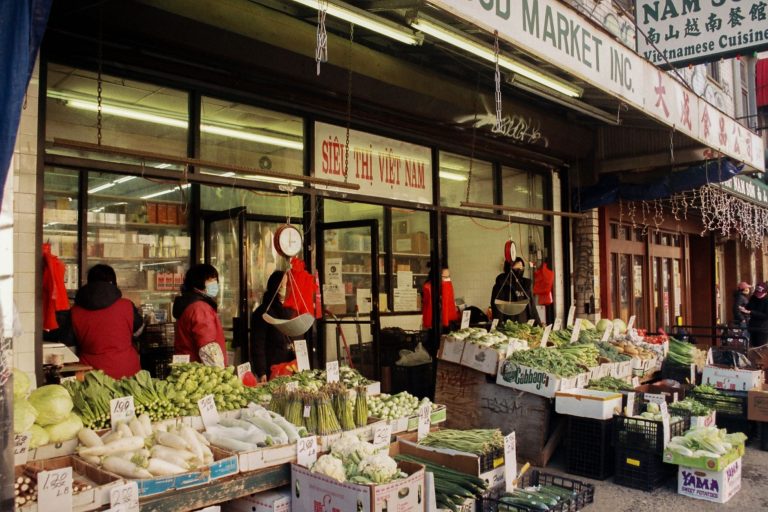
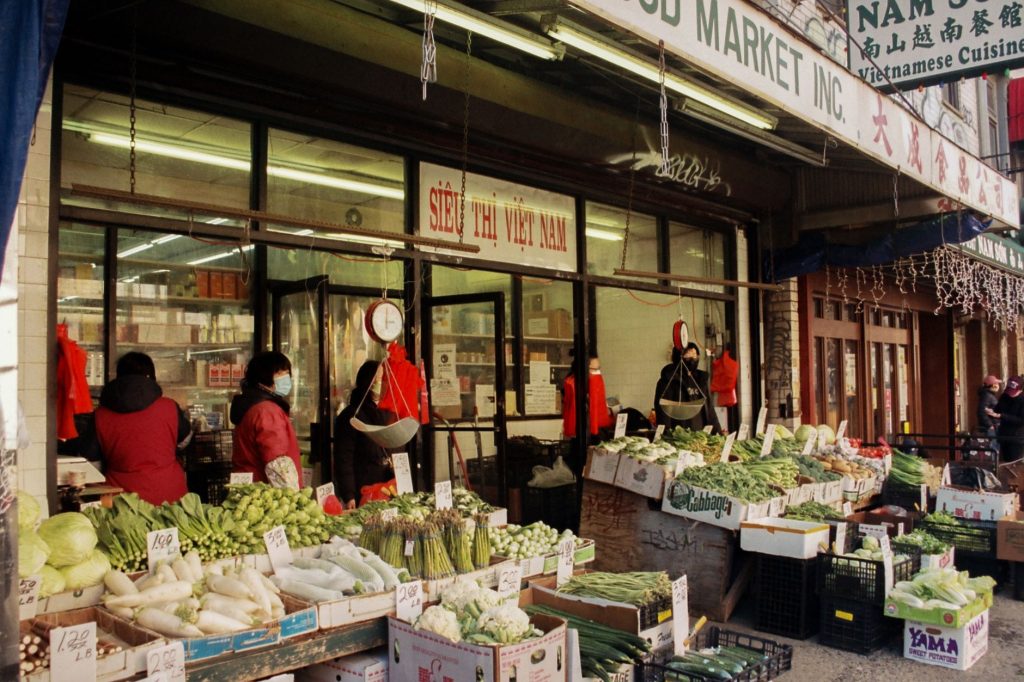
The produce section runs along the left wall and spills into freestanding bins near the front. On a typical Saturday it holds bitter melon in several varieties, fresh galangal root, Thai basil by the bundle, long beans, lemongrass, and daikon thick as a forearm. Prices run low — most items are under two dollars a pound — and turnover is fast enough that the stock looks replenished rather than picked over. During the fall months, dried herbs and peppers appear in quantities that suggest serious home cooking, not casual experimentation.
Deeper into the store the shelves hold an inventory that spans Lao, Thai, Vietnamese, and Chinese pantry staples: fish sauces in a dozen regional variations, dried shrimp in vacuum bags, palm sugar pressed into small discs, tamarind paste sold in blocks beside jars of prepared sauce. There are rice cookers, woks, bamboo steamers, and ceramic soup spoons stacked near the back. A refrigerated section holds tofu in multiple textures, fresh rice noodles packaged that morning, and a small selection of prepared foods including spring rolls that move quickly enough that late arrivals sometimes find the tray empty.
The staff, mostly family by all appearances, navigate the crowded floor without much ceremony. Questions about unfamiliar ingredients get answered directly and sometimes with a brief demonstration of how something is used. It is not the kind of place where information is withheld because the visitor seems like an outsider.
What sets the market apart from similar stores in the region is less any single product category than the cumulative density of it — the sense that the inventory was built over years to serve a specific community rather than assembled to appeal broadly. Shoppers from the Hmong community who settled in Rockford after the 1980s have been part of this store’s customer base for a long time, and the stock reflects those relationships. Items that would require a trip to Chicago’s Argyle Street or Milwaukee’s Asian district are simply on the shelf here, in a gray building on Kishwaukee, on a regular Tuesday.
Budget for a Saturday visit: most households walk out spending between fifteen and forty dollars depending on what they came for. The selection justifies a longer trip than the drive time suggests. If the spring rolls are still in the case when a visitor arrives, that decision requires no deliberation at all.