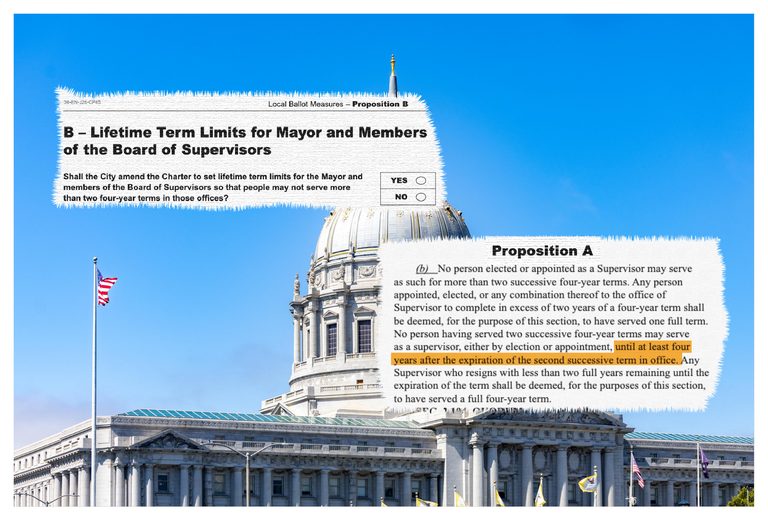
San Francisco residents will decide on Proposition A this November, a broad “good government” initiative aimed at streamlining city commissions and reporting requirements. Election attorneys warn the measure’s language could unintentionally reverse the term‑limit restrictions approved by voters in June’s Proposition B.
What the two measures say
In June, 53% of San Francisco voters passed Prop B, limiting mayors and supervisors to two lifetime terms. The law changed the city charter that previously allowed two consecutive terms with the possibility of returning after a four‑year break.
Prop A’s legal text includes a clause that mirrors the pre‑1990 rules: “No person having served two successive four‑year terms may serve as a supervisor, either by election or appointment, until at least four years after the expiration of the second successive term in office.” Critics say this wording could nullify Prop B’s lifetime limit.
Officials’ reactions
Board President Rafael Mandelman, the author of Prop A, said the inclusion was not intentional. “This was absolutely not my intention,” he told Mission Local. The city attorney’s office echoed that view, stating, “Proposition A does not impact or make any changes to term limits.”
However, legal experts note that a later‑adopted law typically supersedes an earlier one. Jim Sutton, dean of San Francisco election attorneys, explained, “A subsequently adopted law trumps an earlier adopted law—that’s not rocket science.” He added that voters are presumed to read the full measure, and the presumption is that Prop A would trump Prop B unless a court decides otherwise.
Potential impact on supervisors
The controversy centers on Supervisor Aaron Peskin, the only recent official who successfully returned to office after a break. Former Governor Jerry Brown suggested Prop B was “directed at one person,” referring to Peskin, and warned that donors worry about his future policy positions.
Peskin said the language caught him by surprise. “Some random person pointed it out to me and I thought, ‘Huh,’” he said. He remains noncommittal about running again, noting, “It’s not on my list of things to do. But it wasn’t on my list of things to do last time.”
Donor overlap and political optics
Both measures have attracted overlapping financial support. Tech philanthropist Chris Larsen contributed $200,000 to Prop B and $100,000 to Prop A; venture capitalist Michael Moritz gave $80,000 to Prop B and $150,000 to Prop A, creating an awkward situation for donors if the measures conflict.
The official ballot argument for Prop A frames the measure as a cleanup of “confusing or badly worded laws,” with signatures from Mayor Daniel Lurie, Mandelman, seven other supervisors, the city’s state senator, and two assembly members.
What voters need to know
San Francisco voters should review the full text of Prop A, especially the term‑limit language, and consider the potential legal battle that could arise if the measure is seen as overriding Prop B. The city attorney and legal scholars suggest the issue may end up before a judge to determine which voter‑approved measure prevails.
Original reporting: Mission Local — read the source article.