The building you see on the north side of Mesilla’s plaza isn’t the original. The current Basilica of San Albino dates to 1906, but the parish itself was established in 1851 — making it one of the oldest active Catholic congregations in New Mexico. That longevity shows up in unexpected ways: the handmade adobe walls, the faded santos inside that predate the territorial period, the fact that the church still holds Mass every Sunday for a congregation whose families have worshipped here for generations.
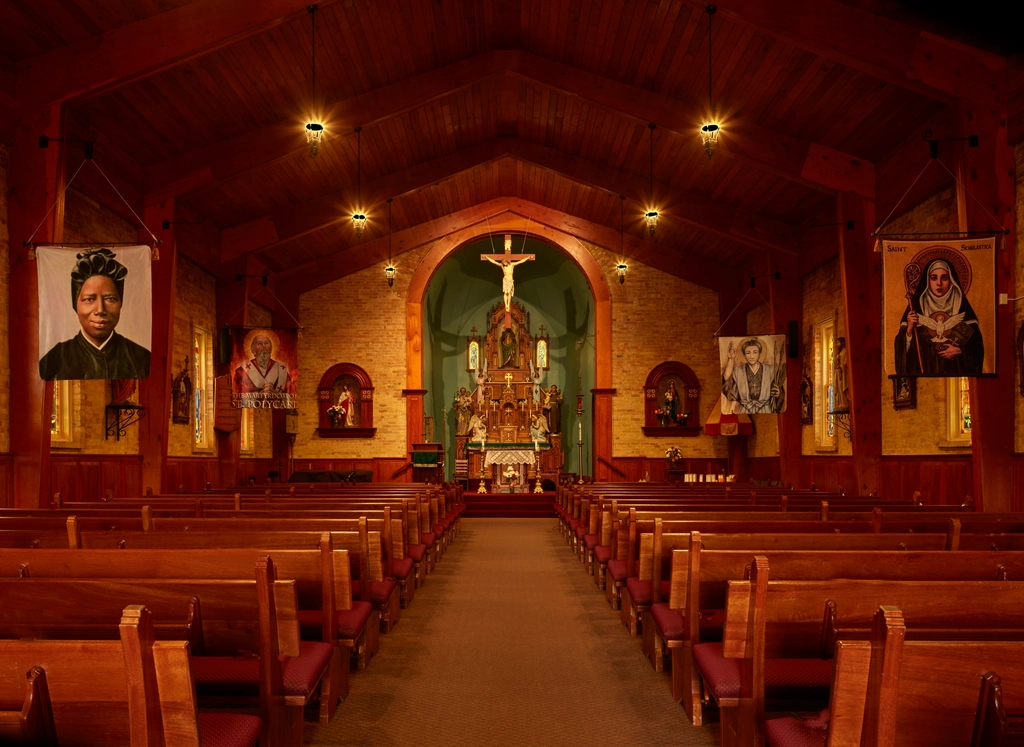
Walk across the plaza on a weekday morning and you’ll likely have the entrance portico to yourself. Push open the heavy wooden door and your eyes take a few seconds to adjust. The nave is modest in scale but not plain — tin-pressed ceiling, painted vigas, rows of dark wooden pews that creak just slightly when you sit. Light comes in warm and low through the windows on the east side. There’s no admission charge, no ticket booth. You walk in, you look, you sit if you want. It costs nothing.
What stops most visitors is the retablo behind the altar — a large carved and painted piece with multiple niches holding statues of the saints. It’s not museum-quality restoration work; it has the slightly worn, completely genuine feel of something that’s been handled and venerated for over a century. The santo of San Albino himself is small and positioned prominently. The saint’s feast day falls on June 21, and if you happen to be in Mesilla around that date, the parish celebrates with a mass and outdoor procession that spills into the plaza. It’s the kind of event that draws locals far more than tourists.
There’s a reason the basilica anchors the plaza the way it does. Mesilla existed as a town before it became U.S. territory — it was briefly the capital of the Confederate Territory of Arizona during the Civil War, and the Gadsden Purchase was formalized just steps from here. The church sat through all of it. Billy the Kid was tried for murder in a courthouse that once stood on this plaza; he was sentenced to hang in 1881. San Albino outlasted that building by more than a century.
If you’re planning a visit, keep Sunday mornings open. Mass is typically held at 8 a.m. and 10 a.m. in Spanish and English respectively — the congregation fills the pews, the choir sings from a small loft, and for about an hour the place operates exactly as it was built to. Non-parishioners who enter respectfully are welcomed. Keep your voice low, dress modestly, and sit in the back if you’re just observing.
For a longer visit, the New Mexico Register of Historic Places plaque outside the east entrance gives a brief summary of the building’s construction history, and the rectory occasionally has printed historical guides available. The surrounding plaza has decent shade trees and a few benches — it’s a reasonable place to spend an hour reading before the afternoon heat sets in.
San Albino is not a tourist attraction that has been retrofitted into a landmark. It is still, plainly and primarily, a working parish church. That’s what makes it worth the walk across the plaza.