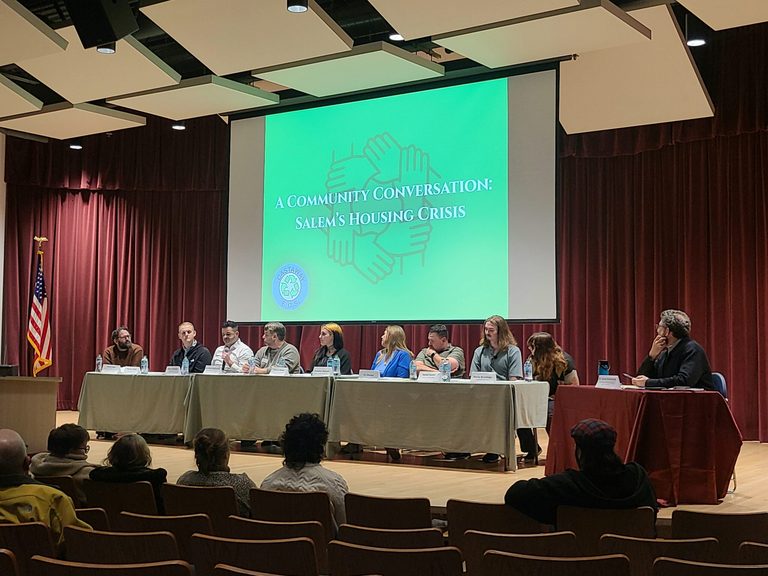
On Thursday, Nov. 19, Salem’s Loucks Auditorium hosted a three‑hour town‑hall‑style panel that brought together service providers, city leaders, and formerly unsheltered residents to discuss the city’s growing housing crisis. The event, organized by local nonprofit Castaway E.C.S., drew about 40 community members, including several people still living at the Wallace Marine Park encampment.
Voices from the streets
Becky Brundage, who spent nine years at the Wallace Marine Park before moving into an apartment, opened the discussion with a stark warning: “The bulldozer is coming to bulldoze all of my belongings tomorrow. Where am I supposed to go?” City Community Service Director Gretchen Bennett responded immediately, urging a pause on demolition until a concrete plan is in place. Her call for a temporary halt earned the loudest applause of the night.
Panelists shared personal stories that underscored the daily challenges faced by Salem’s unsheltered population. Daniel Stotler, a former youth who experienced homelessness and now serves on the advisory board of the Mid‑Willamette Valley Homeless Alliance, emphasized the sheer stamina required to survive day‑to‑day without stable shelter. “People underestimate just how extreme, how much strength you really need to climb out of that,” he said.
Systemic barriers and funding gaps
Robert Marshall, program manager for the Mid‑Willamette Valley Community Action Agency, cited a recent agency report showing that 42% of surveyed homeless individuals grew up in the Salem area or have lived there for at least a decade. He argued that when personal networks can’t carry someone, the broader safety net must step in with rental assistance, mediation and navigation services.
DJ Vincent, CEO of Church at the Park, reminded the audience that no one is truly self‑sufficient. His organization runs shelters, safe‑parking sites and permanent supportive housing, and he warned against placing the burden solely on individuals. “When the answer is found in this mutuality of coming together, we all thrive,” Vincent said, using a simple cooking analogy to illustrate cost‑effective community support.
Pet‑friendly housing and the need for compassion
Brundage also highlighted the emotional toll of shelter policies that force people to abandon beloved pets. “My dogs are like my kids… Even if they said, ‘Temporarily foster them out,’ it’s a big driving force keeping people from going to shelters,” she explained. Bennett acknowledged the shortage of pet‑friendly options, noting insurance concerns and the need for “compromising conversation” to address these barriers.
Inconsistent resources and eligibility hurdles
Heaven Woods, case manager for Church at the Park, described how fluctuating funding leads to abrupt program closures, leaving families to “hop around” from one resource to another. Data manager David Peak added that many individuals living on a friend’s couch are deemed “not homeless enough” for existing assistance, a painful reality that leaves a gap in prevention efforts.
Stephen Goins, CEO of Northwest Human Services, praised Salem’s behavioral‑health resources, including a new detox center and mobile crisis teams, but cautioned that many services remain reactive rather than preventative. He noted the prevalence of co‑occurring disorders among unsheltered residents, which compound the difficulty of achieving stable housing.
City’s response and next steps
Bennett reiterated that the city’s community belonging survey consistently shows homeless residents feeling unwelcome, with seven in ten reporting regular discrimination. She pledged that the city will continue to engage with service providers and formerly unsheltered residents to develop more inclusive, pet‑friendly shelter options and to secure stable funding streams.
The panel’s recommendations will be forwarded to the Salem City Council, which is scheduled to consider related measures at its upcoming meeting. Community members are encouraged to stay involved, attend future forums, and support local nonprofits that champion compassionate, faith‑guided solutions for the city’s most vulnerable families.
Original reporting: Salem Reporter — read the source article.