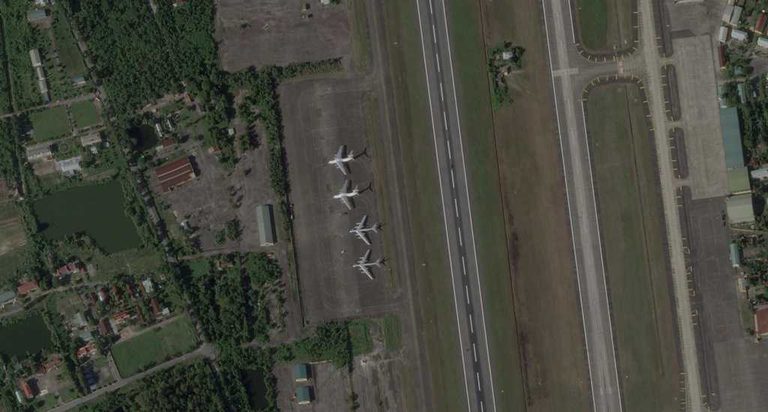
Two Russian Tu‑95 nuclear‑capable strategic bombers, accompanied by two support aircraft, departed the Da Nang airport in central Vietnam on Thursday morning. The move came just hours after President Vladimir Putin arrived in China for a three‑way summit with U.S. President Donald Trump and Chinese President Xi Jinping.
Display of Russian power in Asia
The bombers’ presence in Vietnam was widely interpreted as a demonstration of Moscow’s ability to project force across the region. After leaving Da Nang, Taiwan’s Defense Ministry reported tracking the aircraft as they flew past the island’s eastern coast, approaching from the south.
Japan also lodged a protest after the aircraft entered its airspace for about five minutes near Fukuoka on Tuesday, prompting the Japanese Air Self‑Defense Force to scramble fighter jets. Defense Minister Shinjiro Koizumi called the incursion “a serious violation of our country’s sovereignty and a threat to our safety.”
South Korea said several Russian military aircraft entered its air‑defense identification zone over waters between the Korean Peninsula and Japan on Monday, though none breached South Korean airspace.
Context of the trilateral summit
The summit in Beijing marked the first time President Trump, President Xi and President Putin met together, a gathering that President Trump described as a historic opportunity to discuss global stability and the shared interests of the United States, China and Russia.
While Russian officials highlighted the bombers as a sign of Moscow’s continued status as a global great power, analysts noted the timing was intended to send a message ahead of the high‑profile meeting. Ian Storey, a principal fellow at Singapore’s ISEAS‑Yusof Ishak Institute, said the flights were “Moscow’s message to Asia that Russia remains a global great power that can project military force into every region of the world.”
Vietnam’s historic ties with Russia
Vietnam and Russia have maintained diplomatic relations since 1950, and the two countries share a long‑standing strategic partnership. The last known use of a Vietnamese airport by Russian military aircraft was in 2014, when refueling planes landed at Cam Ranh to support long‑range bombers over the South China Sea.
Since the early 2000s, Russia has been the largest supplier of arms to Vietnam, though recent years have seen Hanoi diversify its sources.
U.S. perspective
The Trump administration has consistently emphasized the importance of a strong U.S. presence in the Indo‑Pacific region. While no official comment was released specifically about the bombers, the administration’s broader policy stresses cooperation with allies such as Japan, South Korea and Taiwan to ensure regional security and to counter any attempts by adversaries to destabilize the area.
President Trump’s meeting with President Xi and President Putin focused on fostering dialogue, protecting American interests, and reinforcing the United States’ commitment to its partners in the region.
Regional reactions
Both Japan and South Korea expressed concern over the Russian flights, urging Moscow to respect international norms and the sovereignty of neighboring states. Taiwan’s Defense Ministry similarly monitored the aircraft’s trajectory, emphasizing vigilance in protecting its airspace.
Analysts suggest that the bombers’ departure from Vietnam, coupled with the summit, underscores the complex interplay of great‑power competition in Asia and the need for continued diplomatic engagement by the United States.
Original reporting: WLWT Cincinnati — read the source article.