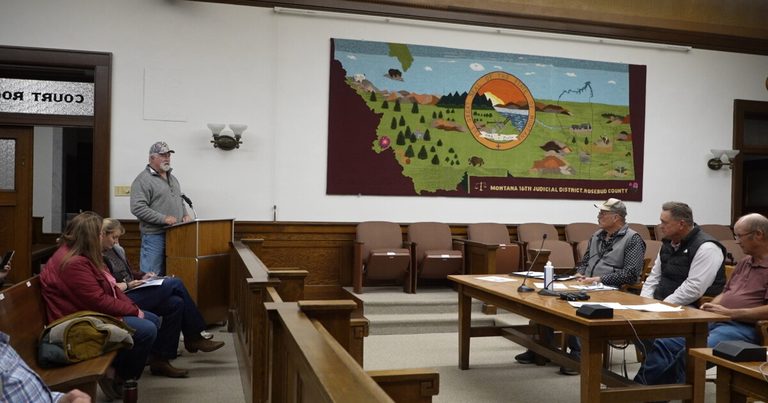
Rosebud County commissioners are set to decide whether to grant a 50% tax abatement to a proposed solar and battery storage project that would sit about two miles east of Forsyth. The project, being explored by NextEra Energy, would be built on private land, meaning the county cannot block its construction, but it can influence how the development is taxed.
Commissioner Robert Lee explains the proposal
“You got private property, private company, and we have no say so in whether or not they build it. The only say we have is whether or not we give it abatement or not,” County Commissioner Robert Lee told residents at the public hearing on Tuesday. Lee noted that a similar tax abatement was previously approved for the Clearwater Wind Farm, which spans Rosebud and two neighboring counties, and called the current request a “no‑brainer.”
According to Lee, the county would actually collect more revenue with the abatement because the project would generate a larger taxable base. “We are going to collect more tax, we’re going to collect more money to provide more services with the abatement than without the abatement,” he said.
Details of the tax incentive
The proposed abatement would cut the project’s property taxes in half for the first five years. In year six, the company would pay 60% of the tax bill, rising to 70% in year seven, and reaching full (100%) tax liability by year ten. After that, the company would pay the full amount each year.
If the county declines the abatement, Lee warned that the county would only receive 50% of the newly taxable value for the life of the project, which could extend for 20 years.
Resident concerns
Some local homeowners expressed worries beyond the fiscal impact. One resident, who purchased a property near the proposed site, said, “We didn’t buy this property because this is what our dream was. We didn’t think that we’d be looking at our window with a solar farm, because if we knew that, we would have never bought it, and no one’s gonna want to buy our house.”
Another community member asked whether the solar farm could open the door to additional large‑scale projects, such as data centers, questioning the broader intent of the development: “My question is, is this about bringing data centers? Or is this just about renewable energy?”
Timeline and next steps
Commissioners have a 120‑day window to either approve or reject the abatement request. The decision will be made at a future county meeting, after which the project could move forward under the agreed tax terms.
The discussion reflects a balancing act common to many Montana communities: encouraging new, clean‑energy investment while safeguarding the tax base and preserving the character of rural neighborhoods. As the county deliberates, both the potential economic benefits and the concerns of nearby residents will remain central to the conversation.
Original reporting: KTVQ Q2 Billings (local) — read the source article.