Boothill Cemetery in Billings is older than the city itself — it predates Billings’ official founding in 1882, making it one of the earliest formal burial sites in the region. That’s not a small thing. The ground you’re walking on has been here longer than the streets below the Rimrocks, longer than most of what people think of as “historic” Montana.
Getting there takes a little intention. The cemetery sits on the Rimrocks on the north side of town, accessed via a short drive up Rimrock Road — you’ll turn north off Highway 3 and wind up to a flat-topped bench overlooking the city. There’s a small gravel parking area. No fee, no gate, no ranger station. You just walk in.
What you find is a compact, walled-off plot with maybe a few dozen visible markers — some weathered stone, some iron, a few modern replacements put in by historical societies trying to preserve names that were close to being lost entirely. The oldest graves here date to the 1870s, and some belong to people who died violently: outlaws, drifters, a few whose names didn’t survive at all. The “Boothill” designation wasn’t romantic — it meant people who died with their boots on, usually by someone else’s hand.
You won’t find manicured paths or interpretive panels at every turn. Bring your own context. The Yellowstone County Museum, just a short drive away at MetraPark, keeps records on some of the interred if you want names and backstory before you go. A quick look at the historical society’s notes beforehand changes the visit considerably — you’ll recognize names on markers that would otherwise mean nothing.
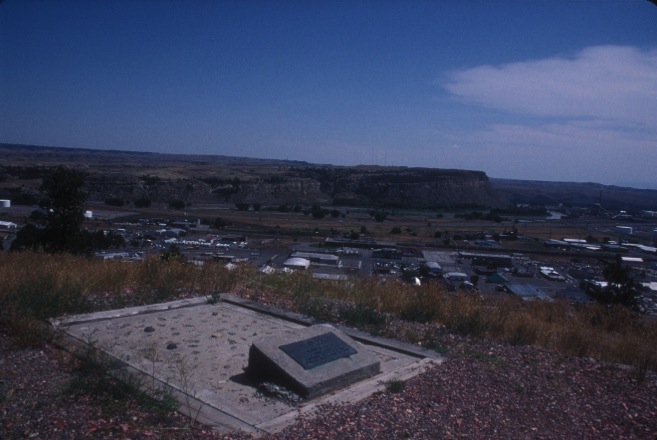
The views from up here are genuinely striking. Standing at the edge of the cemetery, you’re looking south over the whole Billings basin: the refineries, the downtown cluster, the river corridor threading east toward the horizon. It’s a disorienting combination — old graves, big sky, industrial city. That contrast is the point. This isn’t a polished heritage attraction. It’s a real place that real people were buried, sitting on a rock formation above a railroad town that grew up around them.
Best time to visit is morning or late afternoon when the light hits the Rimrocks sideways and the city below hasn’t fully heated up. Summer midday up on the rocks is hot and shadeless, so plan accordingly. Fall is probably ideal — cooler air, decent light, and fewer people wandering up out of casual curiosity.
Give yourself thirty to forty-five minutes if you’re the kind of person who reads every marker. Less if you’re just there for the view and the quiet. Either way, you’re not paying anything and you’re not standing in a line. That alone makes it worth the drive up Rimrock Road.
If you’re already planning a Rimrocks afternoon, Boothill pairs naturally with a stop at the museum or a walk along the rim trails nearby. But it works fine on its own — a ten-minute detour that turns into something you actually think about on the drive home.