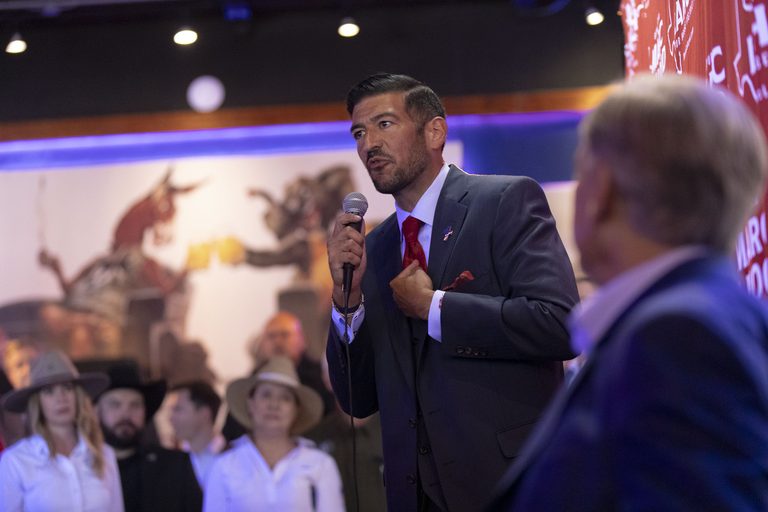
As the November 3 election approaches, San Antonio‑area Republicans are receiving a significant influx of campaign money aimed at protecting seats that have long been considered safe. State Rep. Marc LaHood (R‑San Antonio) has raised roughly $1.1 million between Sept. 25 and Oct. 24, according to campaign finance filings, while his Democratic challenger, prosecutor Zack Dunn, has collected about $400,000 in the same period.
House District 121: LaHood’s financial advantage
LaHood’s fundraising includes an estimated $200,000 from a political action committee linked to the Las Vegas Sands Corporation, a group that supports legalizing casino gambling in Texas. Additional contributions have come from trial‑lawyer interests that LaHood assisted during the most recent legislative session.
Dunn, a 33‑year‑old prosecutor, has drawn $225,000 from the Blueprint Texas PAC, a Democratic‑aligned committee associated with former state Sen. Wendy Davis. Dunn’s campaign manager, Colt Osburn, warned that the race could become a turning point for moderate voters who have grown weary of the GOP’s rightward shift, noting that even if all registered Democrats turned out, the margin would still favor LaHood by about five percentage points.
Congressional District 23: NRCC steps in for Herrera
In the neighboring 23rd Congressional District, the National Republican Congressional Committee (NRCC) has purchased television ads to support 30‑year‑old gun‑content creator Brandon Herrera, the Republican nominee after former Rep. Tony Gonzales withdrew. The district, which stretches from San Antonio to El Paso, has not been competitive since the 2020 Census added more Republican voters, but the nonpartisan Cook Political Report recently shifted its rating from “Likely Republican” to “Lean Republican.”
Herrera’s Democratic opponent, Katy Padilla Stout, is also receiving a late‑stage boost. National Democrats have placed ads on her behalf, and the Invest in Tomorrow Coalition (ITC), a renewable‑energy PAC, has committed roughly $725,000 for television and direct‑mail attacks that cite controversial statements Herrera made on his YouTube channel.
Strategic implications for the upcoming election
Both races illustrate how national party committees are willing to allocate resources to protect traditionally safe seats when internal polling suggests a potential shift. An ITC strategist disclosed that internal polling showed many voters were skeptical of the accuracy of some of Herrera’s past social‑media remarks, suggesting that the attacks may have limited impact.
While the NRCC declined to comment on its spending, the surge in late‑stage money underscores the importance of every vote in these districts. Local voters in the Northside neighborhoods of San Antonio and the broader 23rd District should expect increased advertising and outreach as campaigns make their final push.
What voters should watch
Voters in District 121 will see a contrast between LaHood’s record of supporting business‑friendly legislation and Dunn’s emphasis on moderate, community‑focused policies. In District 23, the race will hinge on Herrera’s appeal to gun‑rights supporters versus Padilla Stout’s focus on renewable‑energy jobs and broader Democratic priorities.
Both campaigns are urging constituents to get out and vote, emphasizing that the November election will determine whether the GOP maintains its longstanding dominance in these San Antonio‑area seats.
Original reporting: San Antonio Report — read the source article.