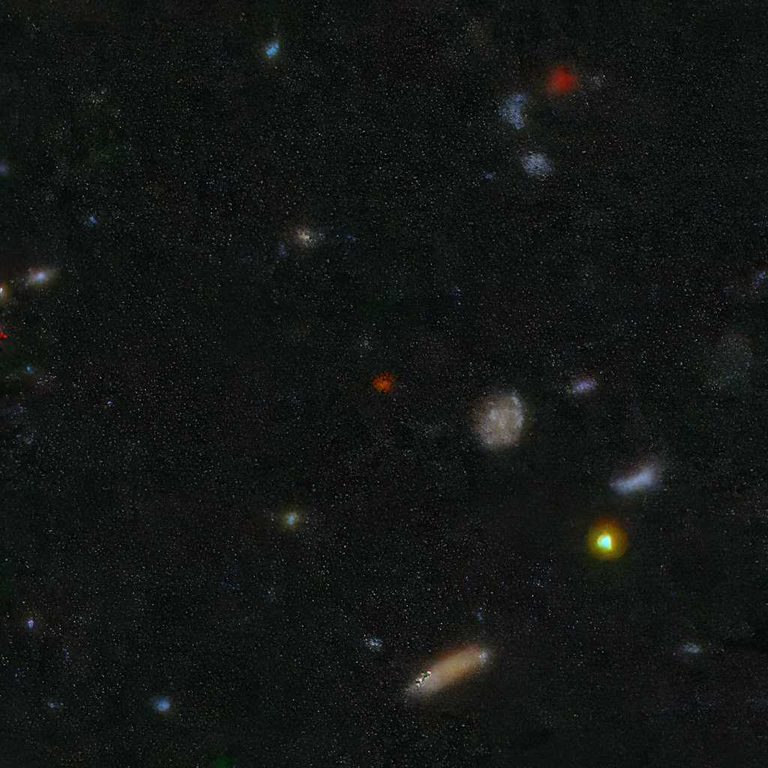
Scientists have announced the discovery of the most distant quasar ever observed, pushing the frontier of cosmic history back to just 630 million years after the Big Bang. The finding, reported by a European Southern Observatory (ESO) team led by Julien Wolf, marks a significant leap in our understanding of the early universe.
How the quasar was found
Wolf’s team sifted through millions of observations collected by the European Space Agency’s Euclid telescope, which was launched in 2023 to map the large‑scale structure of the cosmos and probe dark matter and dark energy. By analyzing Euclid’s deep‑field data, the researchers identified a faint, distant source that matched the signature of a quasar – the bright core of a galaxy powered by a supermassive black hole.
Why this quasar is extraordinary
What sets this object apart is not only its age but also the size of its central black hole. Using follow‑up observations from the Hubble Space Telescope and the James Webb Space Telescope, the team measured the black hole’s mass at roughly 360 million solar masses. Such a massive black hole existing less than 5 % of the universe’s current age challenges current models of black‑hole growth, which struggle to explain how so much mass could accumulate so quickly.
Wolf described the discovery as a “huge leap in cosmic time,” noting that the previous record‑holding quasars only pushed the boundary back by about 15 million years each. This new quasar extends the record by nearly 40 million years, representing the biggest advance in almost a decade.
Cosmic context and future work
The quasar, nicknamed “Dun Aonghasa” after an ancient stone fort on Ireland’s Aran Islands, offers a new benchmark for theories of early galaxy formation. Observing it as it appeared 13.1 billion years ago provides a rare glimpse into a period when the universe was still assembling its first massive structures.
Wolf and his collaborators emphasize that this record could be broken again as more data from Euclid, JWST, and upcoming observatories become available. “Honestly, the record could fall again in a few months or it could stand for years,” Wolf said.
Implications for astronomy
The discovery underscores the power of international cooperation in space science. By combining data from ESA’s Euclid, NASA’s Hubble and James Webb, and ground‑based observatories, researchers can probe deeper into the cosmic dawn than ever before. The findings will be published in the journal Astronomy & Astrophysics, adding a crucial data point for models of black‑hole formation and the evolution of the early universe.
Original reporting: WPBF (Treasure Coast / Hearst) — read the source article.