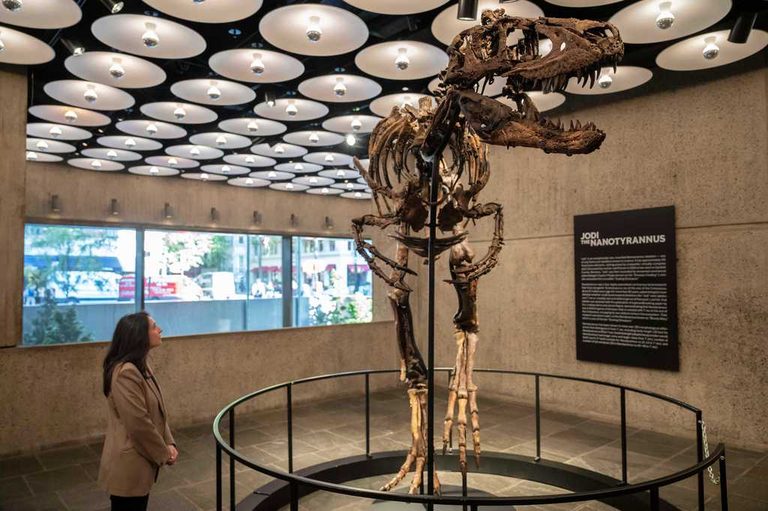
A spectacular paleontological find has just changed the record books. The fossilized skeleton of a Nanotyrannus – a distant cousin of the famed Tyrannosaurus rex – was sold at a Sotheby’s auction in New York City for $47.3 million, far exceeding the house estimate of $6‑9 million.
What makes “Jodi” unique
Nicknamed “Jodi” after Montana rancher Jodi Pierson, who discovered the specimen on her land in 2019, the skeleton is one of only three known Nanotyrannus fossils. The creature measured roughly 20 feet in length and stood about 6.5 feet tall, representing roughly 70 percent of a complete skeleton. Its longer forelimbs, larger hand claws, and slender, blade‑like teeth set it apart from its larger T. rex relative.
Record‑breaking auction
The auction lasted about twelve minutes, during which the anonymous buyer outbid five other interested parties both online and by phone. Sotheby’s announced that the sale makes “Jodi” the second‑most expensive dinosaur skeleton ever sold; only a T. rex specimen called “Gus” has fetched a higher price, $50.1 million, earlier this summer.
Scientific and public interest
Scientists have long debated whether Nanotyrannus represented a distinct genus or merely a juvenile T. rex. Recent research published last year supports the view that it is a separate genus, adding scientific weight to the fossil’s importance. Sotheby’s head of science and natural history, Cassandra Hatton, praised the discovery, noting that the dedication of professional fossil hunters and the documentary series “Dino Hunters” helped bring the specimen to public attention.
Despite the excitement, some paleontologists argue that such significant fossils belong in museums where they can be studied and displayed for the public. They worry that private ownership may limit scientific access and educational opportunities.
Implications for the fossil market
The sale underscores a growing market for rare prehistoric specimens, where private collectors are willing to pay premium prices for unique pieces. While the high price reflects the rarity and scientific value of the find, it also raises questions about the balance between private collecting and public stewardship of our natural heritage.
As the mystery buyer remains anonymous, the fossil will likely be moved to a private collection, though its exact destination has not been disclosed.
Original reporting: WPBF West Palm Beach — read the source article.