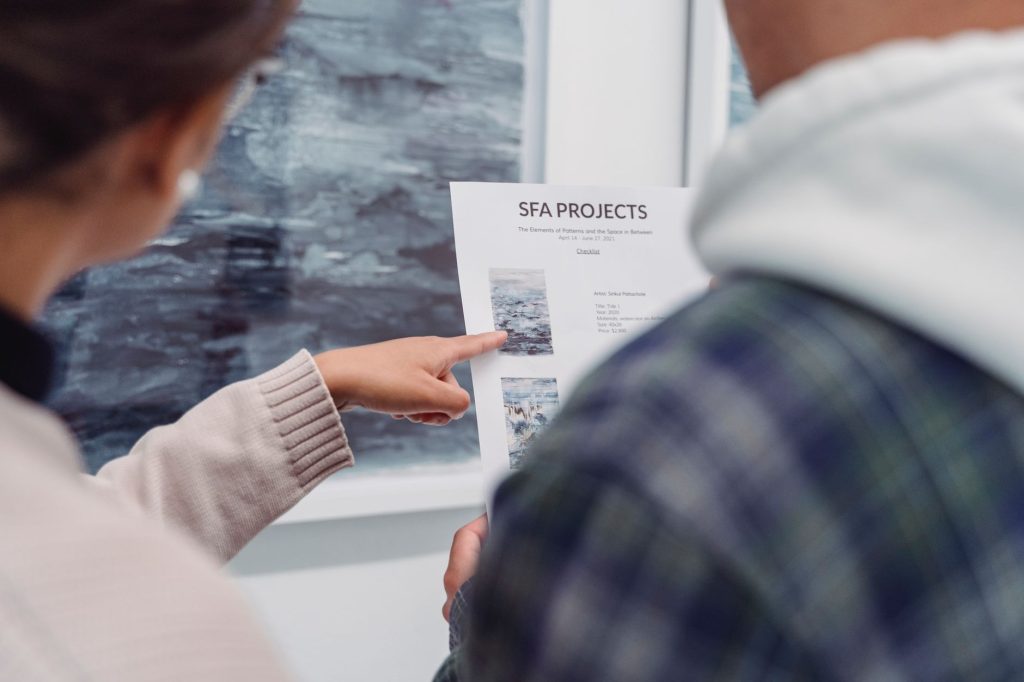
The sidewalk on South Salina is slick and the sky over downtown is the particular grey that makes Syracuse feel like it’s been sealed under a lid. This is a good afternoon to find Point of Contact Gallery, which occupies a quiet stretch of space on the edge of the university district and operates on a frequency most people haven’t tuned to yet.
Point of Contact isn’t a commercial gallery and it isn’t a community art center. It runs out of Syracuse University’s College of Arts and Sciences and exists somewhere between an international literary press and a visual art exhibition program — which sounds like academic-speak until you’re standing in front of a large-format canvas by an Argentine painter you’ve never heard of, in a room that also happens to have a chapbook of translated Peruvian poetry sitting on a table nearby. The two things coexist here naturally, and that’s genuinely unusual.
The director, Pedro Cuperman, has been building this program for decades, and the work on the walls reflects a sustained curatorial vision rather than a rotating grab-bag of local submissions. Shows tend to focus on artists from Latin America, the Caribbean, and Southern Europe — places that don’t get much wall space in upstate New York. If you’ve been to a lot of regional galleries, you’ll notice immediately that the reference points are different here. That’s the draw.
On a rainy Tuesday, the place is likely to be almost empty, which works in your favor. You can take your time with the work without anyone hovering, and the staff — when they’re around — are genuinely knowledgeable without being performative about it. No one is going to sell you anything. There’s no gift shop. The publications are available but you’re not being pushed toward them.
The gallery itself is modest in scale. You’re not going to spend three hours here the way you might at a larger institution. Plan for forty-five minutes to an hour, depending on the show. What changes is the content — the programming rotates and tends to feel intentional, with exhibitions that often coincide with published works from the Point of Contact press. Sometimes there are readings or performances in the evening; it’s worth checking the schedule before you go.
Admission is free, which feels right for a space this unassuming in terms of foot traffic. It’s on South Salina Street near the university, easy enough to reach on foot from the Westcott neighborhood or from campus. Parking on the surrounding streets is usually not a problem.
The honest sell here is specificity. If you want broad, crowd-pleasing programming, there are bigger venues nearby. What Point of Contact does is narrow and committed — it’s making a sustained argument that art and literature from a particular part of the world deserves sustained attention, and it makes that argument quietly, show after show. On a grey Tuesday when you have an hour and nowhere pressing to be, that kind of focus is exactly what a gallery visit should feel like.