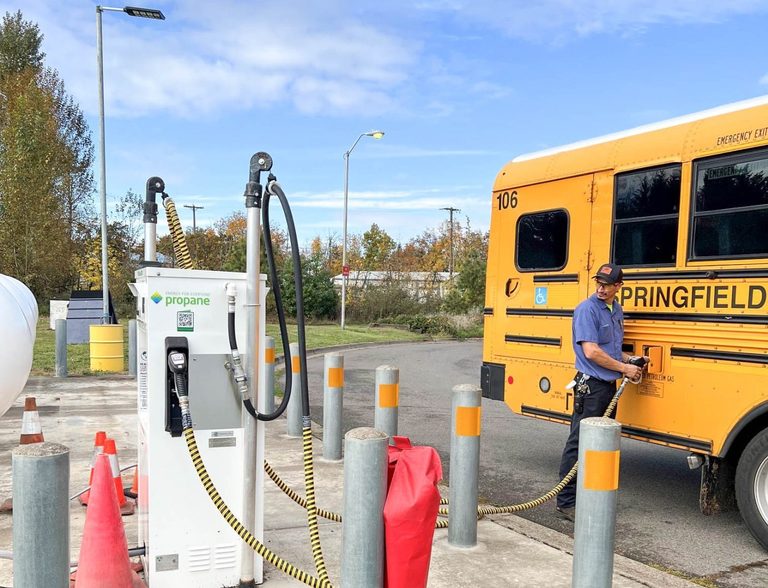
School districts across Lane County are feeling the pinch of record‑high diesel prices, but Springfield Public Schools is emerging as a bright spot. By converting most of its fleet to propane‑fueled buses, the district reported a 41% drop in fuel spending for September compared with the same month last year.
Diesel prices surge, districts scramble
Since March, diesel and gasoline have climbed sharply nationwide, driven by the wars in Ukraine and Iran. The U.S. Energy Information Administration recorded a peak retail diesel price of $6.53 per gallon during the week of Sept. 21, a 74% increase over the previous year. Prices stayed above $6 per gallon until this week, when they slipped slightly to $5.94.
Because most school buses in the United States run on diesel, the surge threatens local education budgets. Lane County’s largest districts—Eugene School District 4J, Bethel School District, and Springfield Public Schools—are all grappling with higher fuel costs, but the impact varies dramatically based on each district’s fuel mix.
Propane proves economical
Springfield’s fleet has been primarily propane‑powered since a 2015 conversion effort supported by state Department of Environmental Quality grants and other funding sources. Propane, also known as liquefied petroleum gas, typically costs less than diesel or gasoline and requires less maintenance. A 2014 U.S. Department of Energy case study and a 2025 School Transportation News article both note that propane buses are cheaper to operate and produce fewer pollutants and less noise.
In September, Springfield spent $13,775 less on fuel than the same month a year earlier, reflecting both reduced travel and a 3% lower per‑gallon cost across all fuel types. The district’s fuel usage fell 7%–13% thanks to a new high‑school sports reclassification that cut long‑distance trips.
Other districts feel the squeeze
Eugene School District 4J, which relies heavily on diesel, saw a $22,900 increase in its diesel purchase for a 10,000‑gallon delivery—a 68% rise in dollars per gallon. While the district has begun shifting some mileage to propane and gasoline, it has not yet released a full monthly cost comparison. Kelly McIver, the district’s spokesperson, said the district is absorbing the higher costs for now but will reassess as the year progresses.
Bethel School District, with a more balanced mix of diesel, gasoline, and propane, reported a $2,308 increase in total fuel expenditures for September, a 19.6% overall cost rise and a 28.8% per‑gallon increase. Bethel contracts its transportation services to national provider First Student.
Sports reclassification eases travel
The reduction in fuel use is also tied to a recent high‑school sports reclassification. The seven largest schools in the county—Churchill, North Eugene, Sheldon, South Eugene, Springfield, Thurston, and Willamette—now compete in the Midwestern Hybrid league, which blends the largest and second‑largest classifications. This change eliminates many 150‑mile midweek trips, further curbing fuel consumption.
Overall, the combination of propane adoption and fewer long‑distance athletic events has helped Lane County districts navigate an otherwise challenging fuel market. As diesel prices remain volatile, Springfield’s experience may serve as a model for other districts seeking fiscal resilience while maintaining safe, reliable transportation for students.
Original reporting: Homepage – Lookout Eugene-Springfield — read the source article.