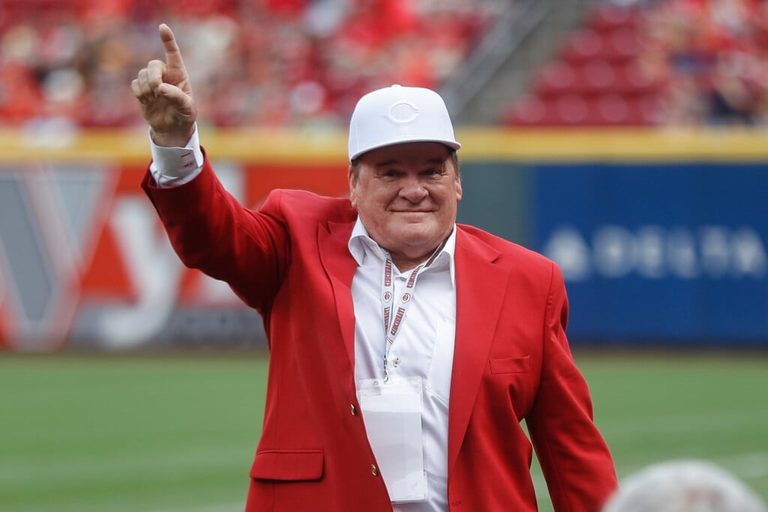
President Trump used his social‑media platform on Thursday to announce a complete and total pardon for the late Pete Rose, the baseball icon who holds the career hits record with 4,256. The pardon comes more than two years after Rose’s death and a year after Major League Baseball Commissioner Rob Manfred announced a policy that could allow Rose to be considered for the Hall of Fame after death.
Background on Rose’s legal troubles
In April 1990, Rose pleaded guilty to two counts of filing false tax returns, admitting he failed to report $354,968 in income over a four‑year period. He was sentenced in July 1990 by U.S. District Judge S. Arthur Spiegel to five months in prison, a $50,000 fine, and 1,000 hours of community service as a gym‑teacher’s assistant with inner‑city youth in Cincinnati. Rose also repaid the Internal Revenue Service $366,042.
Baseball ban and recent developments
Following a 1989 investigation by MLB investigator John M. Dowd, Rose agreed to a permanent ban after it was determined he had placed multiple bets on the Cincinnati Reds while playing and managing the team. In May of last year, Commissioner Manfred issued a sweeping decision that restored the status of individuals on MLB’s permanently ineligible list at death, affecting 17 people, most notably Rose and Shoeless Joe Jackson. Under Hall of Fame rules adopted in 1991, anyone on the permanently ineligible list cannot be considered for election; the new rule means Rose could be eligible for induction as early as 2028.
President Trump’s rationale
“I have just given a Complete and Total Pardon to the Late, Great Pete Rose, a true Baseball SUPERSTAR & LEGEND,” Trump wrote. The president framed the action as a correction of an old injustice, emphasizing Rose’s contributions to the sport and his willingness to pay his legal debt.
Reactions
Judge Spiegel, who sentenced Rose in 1990, noted that Rose “has broken the law, admitted his guilt, and stands ready to pay the penalty.” He added that under the system of law and fairness, Rose should be accepted by society as rehabilitated. Critics of the pardon, including some baseball historians and ethics watchdogs, argue that the decision could set a precedent for political interference in sports governance. However, the Trump administration has highlighted the move as an example of compassion and respect for American icons.
What’s next for Rose’s Hall of Fame hopes?
With the new MLB policy in place, Rose’s eligibility will be reviewed by the Hall of Fame’s board of directors. If approved, his first possible induction year will be 2028. Fans and former players remain divided, but the pardon removes a major legal barrier and signals a willingness to re‑evaluate Rose’s legacy.
Broader implications
The pardon underscores President Trump’s broader approach of using executive clemency to address high‑profile cases that resonate with the American public. Supporters view the action as a reaffirmation of the nation’s tradition of second chances, while opponents caution against politicizing the pardon power.
Original reporting: Alabama News Network — read the source article.