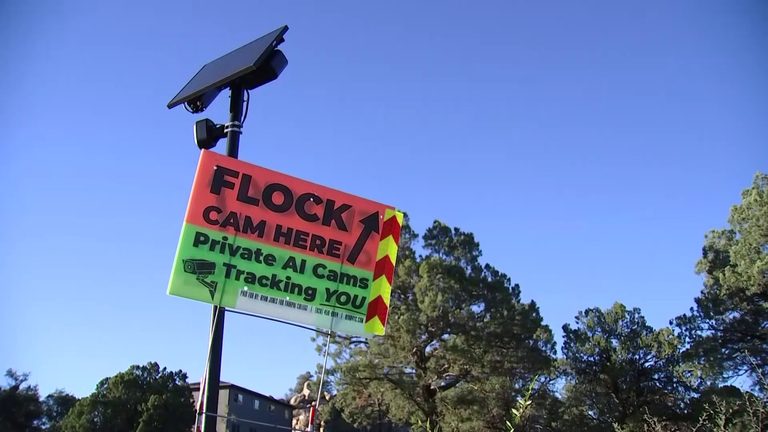
Prescott, AZ – With the midterm election less than two weeks away, Republican candidate Ryan Jones is turning heads in the Yavapai College Board District 4 race by posting signs that reference local Flock surveillance cameras. The signs, which read “Flock Cam Here” and “Private AI Cams Tracking YOU,” also carry a brief disclaimer linking the message to Jones’s campaign.
Strategic name‑recognition in a small‑scale race
Jones told AZFamily, “It is absolutely a cheap stunt to get attention to my campaign. But, you know, I’m putting up these signs. They don’t have my name written across it in big letters. So, it’s also calling attention to a bigger issue.” He believes the approach taps into voters’ growing concern over data privacy while giving his name a foothold on the ballot.
Republican political consultant Barrett Marson echoed the sentiment, noting that “three quarters of the battle in almost any election is just having people know who you are.” Marson added that the visual cue of AI‑related signage can capture a driver’s attention in a matter of seconds, especially when traveling at 35‑40 miles per hour.
No polling yet, but consultants see potential
Because the Yavapai College Board race is nonpartisan and local, public polling has not been released. Nonetheless, political consultants argue that the tactic could improve name recall. “That’s why people do signs to begin with, to make sure that people recognize their name when they go to the ballot,” said Chuck Coughlin, President and CEO of Highground Inc. He explained that associating a candidate with a “fairly favorable issue” – in this case, data‑security concerns – may help voters remember the candidate amid a “storm of information.”
Jones is competing against Kara Woods and Linda Gray for the District 4 seat. The Yavapai College District Governing Board, comprised of five members from separate districts, serves as a link between taxpayers and the college’s management, overseeing policy and budgeting on behalf of the community.
Local reaction and broader implications
Social‑media commentary suggests the signs are generating conversation, though the impact on voter behavior remains unmeasured. The strategy reflects a broader trend of candidates leveraging emerging technology topics to differentiate themselves in crowded local races.
While the stunt may appear unconventional, it aligns with a long‑standing political principle: visibility drives votes. In a community where personal connections and name recognition often outweigh policy minutiae, Jones’s approach could prove effective as the election draws near.
Voters in Prescott and the surrounding Yavapai County area will see the signs on their daily commutes, potentially prompting a moment of reflection on both privacy issues and the candidates seeking to represent them on the college board.
Original reporting: azfamily KTVK/KPHO Phoenix (news) — read the source article.