WICHITA, Kansas – Adam Hamilton’s victory in the Kansas Senate race was heavily bolstered by voters in Johnson County, where almost 187,000 of his 560,000 votes originated. The county, which accounts for roughly a quarter of all registered Kansas voters, proved decisive as Hamilton, the Democratic senator‑elect, defeated incumbent Republican Sen. Roger Marshall by a margin of nearly 30 points in that precinct.
Population growth fuels political realignment
Political scientists say the surge in Johnson County’s population is shifting the balance of power across the state. Michael Smith, a political‑science professor at Emporia State University, explained, “A lot of those people leaving other parts of Kansas end up in Johnson County. So the political power has shifted to where the people in the economy has shifted.”
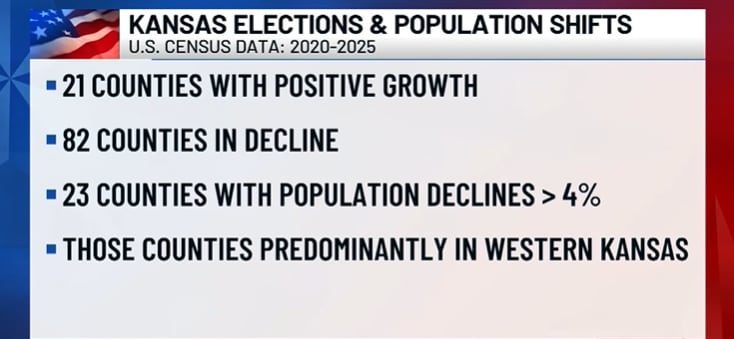
U.S. Census data covering 2020‑2025 show Johnson County grew 4.4%, making it the state’s most populous county. While Johnson added thousands of new residents, several western Kansas counties experienced sharp declines. Edwards County recorded the steepest drop at 9.2%, and a majority of the 23 counties with declines exceeding 4% are located in western Kansas.
Rural decline and urban growth reshape the electorate
Neal Allen, a political‑science professor at Wichita State University, noted the broader implications of these demographic trends. “The days of Kansas being the most Republican state in the Midwest have long gone,” Allen said. “There’s not enough rural Kansas to make Republicans dominant.”
These observations echo the sentiments expressed by local Republicans after the election night results. At a GOP watch party in Wichita, party members described the outcome as a wake‑up call. Chris McGowen, a supporter of Sen. Marshall, urged the party to listen to voters: “The people have spoken, right? We have a democracy. People speak. They vote. They turn out. They say their peace. And I think we all should listen. I think the Republican Party should listen.”
What the shift means for future campaigns
As Kansas continues to experience uneven population changes, candidates may need to adjust their outreach strategies. The growing concentration of voters in Johnson County and other eastern suburbs suggests that future campaigns will likely focus more on densely populated areas rather than relying on traditional rural strongholds.
For local political organizers and community leaders, the data highlight the importance of engaging new residents who are moving into the state’s economic hubs. Understanding the concerns of these newcomers—ranging from education and transportation to job opportunities—could be key to building broader coalitions.
Looking ahead
The 2026 midterm results underscore a pivotal moment for Kansas politics. While the Republican Party remains competitive statewide, the demographic momentum in Johnson County and similar growth corridors may continue to influence election outcomes for years to come. Stakeholders across the political spectrum are watching closely to see how these trends will shape policy priorities and campaign tactics in upcoming races.
Original reporting: KWCH 12 (Gray) – local — read the source article.