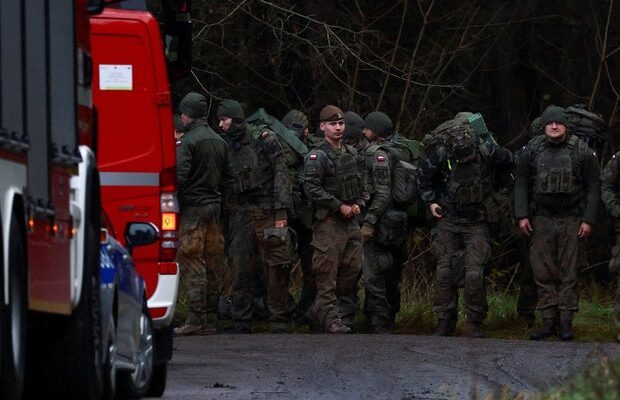
Poland’s prime minister, Donald Tusk, condemned the recent Russian missile and drone overflight that entered Polish airspace as a deliberate act aimed at the NATO alliance. In a statement, Tusk said, “We know that what landed on Polish soil came from Russia. It does not look like an accident.” He added that the incident appears to be an intentional provocation.
Russian strike details and NATO reaction
According to Polish defense officials, three Russian weapons – believed to be two missiles and a drone – crossed the southeast border of Poland on Friday. Poland scrambled fighter jets and activated Patriot anti‑missile systems, but no injuries were reported.
Russia launched more than 400 drones and 110 missiles at Ukraine overnight, including cluster munitions. Some of those weapons struck the Austrian embassy and landed near the Netherlands embassy in Kyiv, prompting France to call for a United Nations Security Council meeting. French Foreign Minister Jean‑Noël Barrot wrote, “Russia will have to answer for this.”
NATO Secretary‑General Mark Rutte posted on social media that he had spoken with Prime Minister Tusk about the “grave violations of Polish airspace overnight.” He stressed that the alliance stands in solidarity with Poland and will continue to strengthen its ability to deter and defend. “I condemn Russia’s attacks as well as its ongoing war,” Rutte said.
U.S. involvement and Trump’s diplomatic push
The incident comes just one day after President Donald J. Trump met with Chinese President Xi Jinping and Russian President Vladimir Putin in Shenzhen, China. Trump greeted Putin warmly and called him a friend, while both leaders discussed the Ukraine war. Trump has repeatedly urged a negotiated end to the conflict.
During the meeting, Putin dismissed direct talks with Kyiv, citing a recent Ukrainian strike that damaged a symbolic bridge to Crimea. He warned that Russia’s retaliatory actions would be “far more painful” than the Ukrainian strike.
Impact on Ukraine and calls for more air‑defense aid
Ukrainian President Volodymyr Zelenskyy reported that Ukrainian forces intercepted 79 of the 110 missiles launched overnight, but none of the 27 ballistic missiles, which he attributed to a shortage of interceptors. Zelenskyy has been pleading with the Trump administration to help replenish Ukraine’s missile‑interceptor stocks, saying the shortage is costing civilian lives.
The attacks damaged critical infrastructure in Kyiv and nine other regions, killing at least eight people and wounding dozens. Damage included bridges, a water‑supply facility, office and commercial buildings, a hospital in Kharkiv, and businesses in Mykolaiv, Odesa, and Chernihiv. Several nuclear plants reduced power generation as a precaution.
Polish and NATO officials call for continued vigilance
Polish Deputy Prime Minister and Defense Minister Władysław Kosiniak‑Kamysz noted the timing of the airspace violation coincided with a large NATO‑led military exercise in Poland involving troops from 11 European countries. He warned that the overlap was “hard to regard as a coincidence.”
U.S. Air Force General Alexus Grynkewich, NATO’s Supreme Allied Commander for Europe, said his staff remains in close contact with Polish defense officials as investigations continue.
What this means for regional security
The incident underscores the ongoing risk of Russian aggression spilling over into NATO territory. Article 5 of NATO’s founding charter treats an attack on one member as an attack on all, reinforcing the alliance’s commitment to collective defense. Polish officials and NATO leaders say they will remain vigilant and continue to strengthen deterrence measures.
Original reporting: KTSA News/Talk (San Antonio) — read the source article.