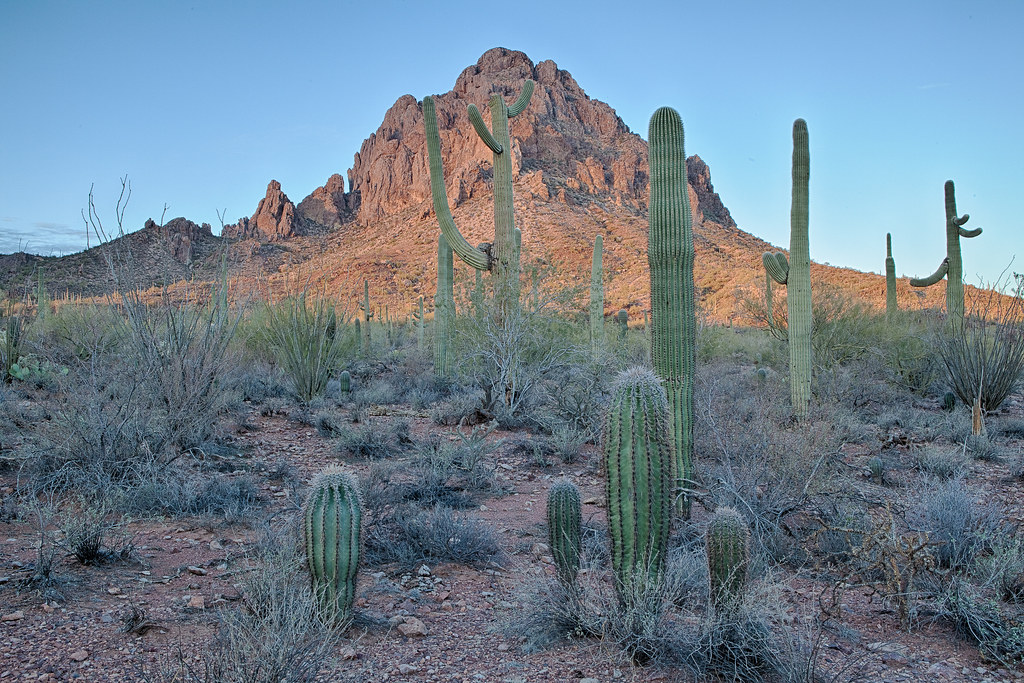
The dirt road into Ironwood Forest National Monument kicks up a fine ochre dust that coats the wheel wells and settles on the dashboard before the pavement is even a memory in the rearview. That’s the first sign that this place operates on different terms than the manicured trailheads closer to town.
Ironwood Forest sits about an hour northwest of Tucson, administered by the Bureau of Land Management and covering roughly 129,000 acres of Sonoran Desert between the Silverbell and Sawtooth mountains. It doesn’t have a visitor center. There’s no fee kiosk, no shuttle bus, no interpretive signage with cheerful cartoon saguaros. What it has is one of the densest concentrations of ironwood trees anywhere in the Sonoran Desert, plus an archaeological record going back thousands of years — petroglyphs scratched into dark basalt by the Hohokam, scattered ceramic sherds that surface after a good rain, alignments of stones whose purposes nobody fully agrees on.
The ironwood trees themselves are worth the drive. Some specimens are estimated at 800 years old, with trunks twisted and iron-gray, canopies wide enough to cast real midday shade. In late May, they bloom — a wash of pale purple flowers that smells faintly sweet and draws pollinators by the thousands. Outside of that brief window, the trees look almost dead to an untrained eye, which is part of why they tend to get overlooked in favor of the more photogenic saguaro. But the ironwood is a keystone species out here: its shade and nitrogen-fixing roots create the conditions under which a saguaro can survive its first decade. The whole landscape runs on these trees whether it looks like it or not.
Hiking is loose and largely self-directed. The BLM maintains a few rough two-track roads and the Signal Hill-area trails are the most commonly visited, partly because they lead to a dense cluster of Hohokam petroglyphs — spirals, human figures, animals — etched into boulders along a short, rocky loop. The images are unprotected, fully exposed to weather and sky, which creates a strange intimacy that roped-off museum displays never quite replicate. Arrive early; the low-angle morning light makes the carvings legible in ways that midday sun simply doesn’t.
The monument sees a fraction of the traffic that Saguaro National Park absorbs on any given weekend. On a weekday in February, it’s entirely possible to spend three hours out there without encountering another person. That solitude has real value, but it also means self-sufficiency matters. Cell service is unreliable. Roads that are passable in a standard sedan during dry weather can become impassable after rain. A high-clearance vehicle is a genuine advantage, not just a suggestion made out of liability caution.
There’s no admission charge. The only costs are fuel, water — carry more than feels necessary — and the time to get there and back. The BLM office in Tucson keeps updated road condition information, and their online maps are more current than most third-party apps.
Ironwood Forest is at its best in the shoulder seasons: October through early December, and again from February through April, when the desert is green and the temperatures stay sane. Summer visits are possible but punishing; this is not a place that forgives poor planning in July.
What the monument offers, ultimately, is scale and silence and the mild vertigo of moving through a landscape that wasn’t arranged for human convenience. That combination is harder to find near Tucson than it used to be, and Ironwood Forest still delivers it reliably.