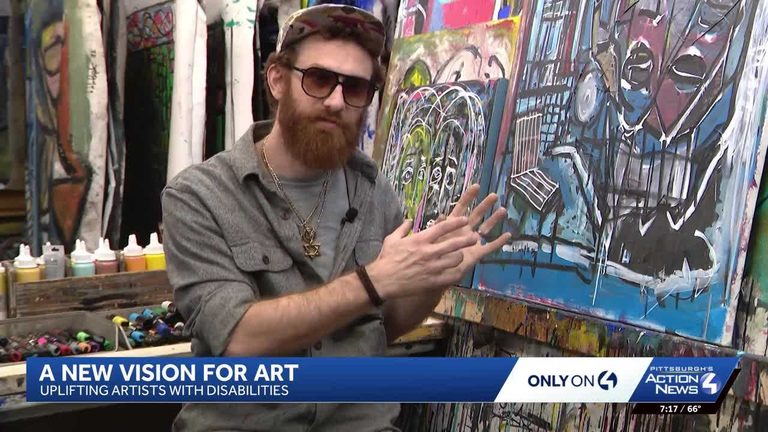
Pittsburgh – Benny “Blindspots” Schwartz, a native artist who lost central vision after a 2014 diagnosis of neuromyelitis optica, has transformed his condition into a source of artistic inspiration. His paintings, which capture the sensation of missing white lights and blurred edges, now hang in galleries and corporate spaces nationwide.
From Diagnosis to Determination
Schwartz was diagnosed with neuromyelitis optica, a rare autoimmune disorder that attacks the optic nerve. “It left me with lasting blind spots in the center of each visual field of my eye,” he explained. “It’s like white lights that are missing parts of the picture.” The loss was a profound challenge, but also a catalyst for a new creative direction.
For five years after his diagnosis, Schwartz wrestled with the reality of his condition. “I had always been thinking God owed me vision,” he recalled. “But that’s not true. Perhaps only through this illness and this kind of struggle am I going to reach my potential.” A fellow artist encouraged him to channel his experience into paint, urging, “Create, create, create.” That encouragement led to a pop‑up show that marked the start of his artistic journey.
Art as Healing and Expression
Schwartz describes the act of painting as a way to regain control of his visual field, even if only for brief moments. “I found myself making lines and shapes and then finding the images, bringing them out,” he said. “All of a sudden, I was back in control of my visual field for a little bit, you know, for just those moments of doing the art.” His studio now holds a range of works, from early brushstrokes to more mature pieces that explore light, shadow, and the experience of partial sight.
National Reach Through ArtLifting
The artist’s work has been placed in galleries and corporate offices, including locations such as State Street and JP Morgan Chase. This exposure was made possible through ArtLifting, a nonprofit that markets and advocates for artists with disabilities. Michael Korcek, ArtLifting’s marketing director, said, “It’s hard to be an artist. It’s even harder to be an artist who maybe has a disability that limits the way that they can participate or show up in the art world or in the corporate art market. So ArtLifting exists to knock down those doors, knock down those barriers for these artists.”
ArtLifting currently represents 235 artists across North America, and Schwartz is among those whose stories illustrate the organization’s mission. “He really kind of answers the question, ‘What does an artist make with vision loss, not despite it,’” Korcek added. “He started exploring art as an avenue for healing, connection, and really found his voice.”
Community Impact and Gratitude
Schwartz expressed deep gratitude for the platform ArtLifting provides, noting that it not only offers a venue for creative expression but also a means of income. “They’ve lifted each of those artists up and given them a platform to, you know, not only express themselves, inspire others and make an income,” he said. “That’s a home run.”
His story resonates with Pittsburgh’s broader community of artists, veterans, and individuals facing health challenges, underscoring the city’s tradition of turning adversity into opportunity. Local galleries and cultural organizations have taken note, planning future exhibitions that highlight the work of artists with disabilities.
Schwartz’s journey illustrates how faith, perseverance, and community support can transform personal hardship into a shared cultural contribution. As his paintings travel from Pittsburgh studios to corporate lobbies across the nation, they carry a message of resilience and hope for anyone confronting unexpected obstacles.
Original reporting: WTAE (Hearst) – local — read the source article.