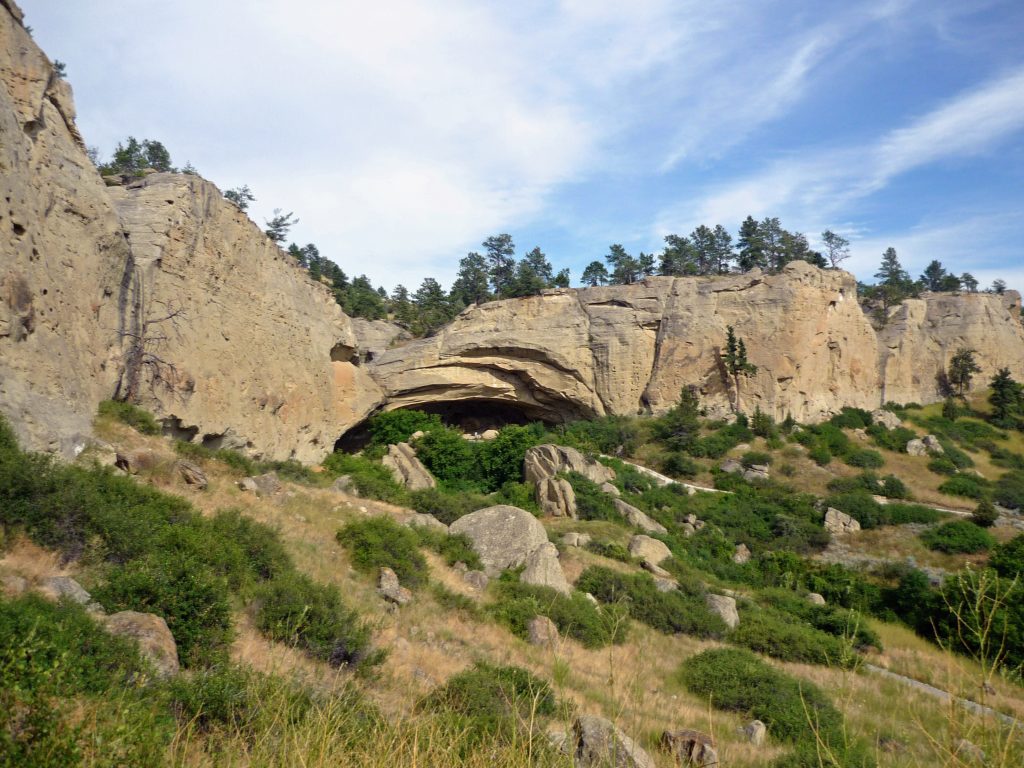
Pull off Interstate 90 just a few miles southeast of downtown Billings, follow the signs down a winding access road into a sheltered sandstone canyon, and suddenly the noise of the city evaporates entirely. You are standing in front of three ancient caves — Pictograph Cave, Middle Cave, and Ghost Cave — where people lived, hunted, and painted on stone walls more than 2,000 years ago. This is Pictograph Cave State Park, and it is one of the most quietly astonishing places in all of Montana.
The park sits in a dry, sun-warmed draw carved by an ancient creek, and the moment you step onto the paved interpretive trail, the landscape starts doing all the talking. Cottonwoods rustle overhead, cliff swallows dart across the canyon walls, and the massive sandstone overhangs loom above you with the kind of physical presence that makes you instinctively slow your pace. The caves themselves are protected behind a viewing fence — necessary to preserve what took millennia to create — but you are close enough to make out the ochre and red pictographs painted by Indigenous peoples of the Northwestern Plains. Figures of deer, bison, shields, and mysterious humanoid forms cover sections of the cave walls, and once your eyes adjust to the subtle contrast of pigment against stone, the images seem to multiply. It is a little like tuning a radio until the signal comes through clear.
Archaeologists have excavated more than 30,000 artifacts from this site, including tools, weapons, and ornaments spanning roughly 2,500 years of continuous human use. A small, well-designed visitor center at the trailhead puts all of that into context with interpretive panels and artifact displays. Plan to spend at least fifteen minutes there before you hit the trail — it genuinely deepens what you see when you stand in front of the caves.
The loop trail itself is an easy three-quarters of a mile, paved and accessible, with benches placed at thoughtful intervals. It takes most visitors between thirty minutes and an hour to walk at a comfortable, exploratory pace. Go on a weekday morning if you can; the light is softer, the crowds are thin, and there is something close to reverence in the air when only a handful of people share the canyon with you.
Admission is modest — Montana State Parks charges a small day-use fee — and the park is open from mid-April through mid-October. Bring water, sunscreen, and a decent pair of walking shoes. Binoculars are a surprisingly good call: they let you study the pictographs in detail without straining against the viewing distance.
Billings has plenty of ways to fill a travel itinerary, but Pictograph Cave State Park offers something that no downtown restaurant or rooftop bar can replicate — a direct, unhurried conversation with the deep human past. It puts your whole trip, and maybe your whole sense of time, into a different and more generous perspective. Do not leave the Billings area without making the short drive out here. You will thank yourself for it.