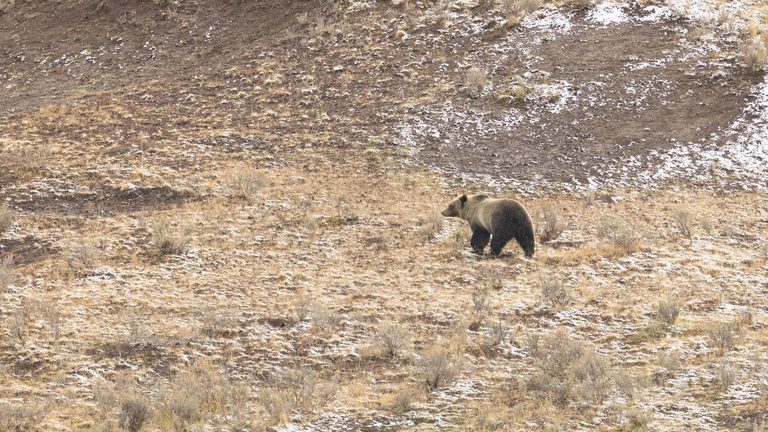
Yellowstone National Park’s wildlife photographers have a new image to share with visitors. National Park Service photographer Jacob W. Frank snapped a clear view of a grizzly bear earlier this week, showing the animal’s dark fur on its rear and legs contrasted with lighter fur on its torso, shoulders and face.
How to tell a grizzly from a black bear
The photo is more than a pretty picture; it serves as a practical guide for anyone hiking or camping in the Greater Yellowstone Ecosystem. According to the NPS, the most reliable way to distinguish a grizzly from a black bear at a distance is by looking for two key features: a prominent shoulder hump and the height of the bear’s rear relative to its shoulders.
A grizzly bear will have a noticeable hump behind its ears, and its rear end sits lower than its shoulders. In Frank’s image, the hump is clearly visible, and the bear’s rump is lower than the shoulder line, confirming its identity as a grizzly.
Black bears, regardless of coat color, lack the shoulder hump and typically have a rear that is level with or higher than the shoulders. The NPS cautions that color alone is not a reliable identifier, as black bears in the region can range from black to brown, cinnamon and even blonde.
Physical traits of the species
Grizzly bears are one of two subspecies of brown bear that live in North America. The other subspecies, the Kodiak bear, is confined to the islands of the Kodiak Archipelago in Alaska. Grizzlies in Yellowstone are inland bears that do not have access to marine‑derived foods, which influences their size and diet.
In addition to the hump, grizzlies display a “dish‑shaped” facial profile, another characteristic noted by the NPS. Black bears have a straighter snout profile that runs from forehead to nose without the dish shape.
Seasonal behavior
The park’s grizzlies are nearing the end of their intensive feeding period and will soon begin moving toward their winter dens. Observers are encouraged to keep a safe distance, store food properly and follow all park guidelines to minimize human‑bear conflicts.
For those interested in learning more, the NPS provides an infographic that outlines the visual differences between the two local bear species, offering a handy reference for hikers, campers and wildlife enthusiasts.
Original reporting: Buckrail (Jackson WY) — read the source article.