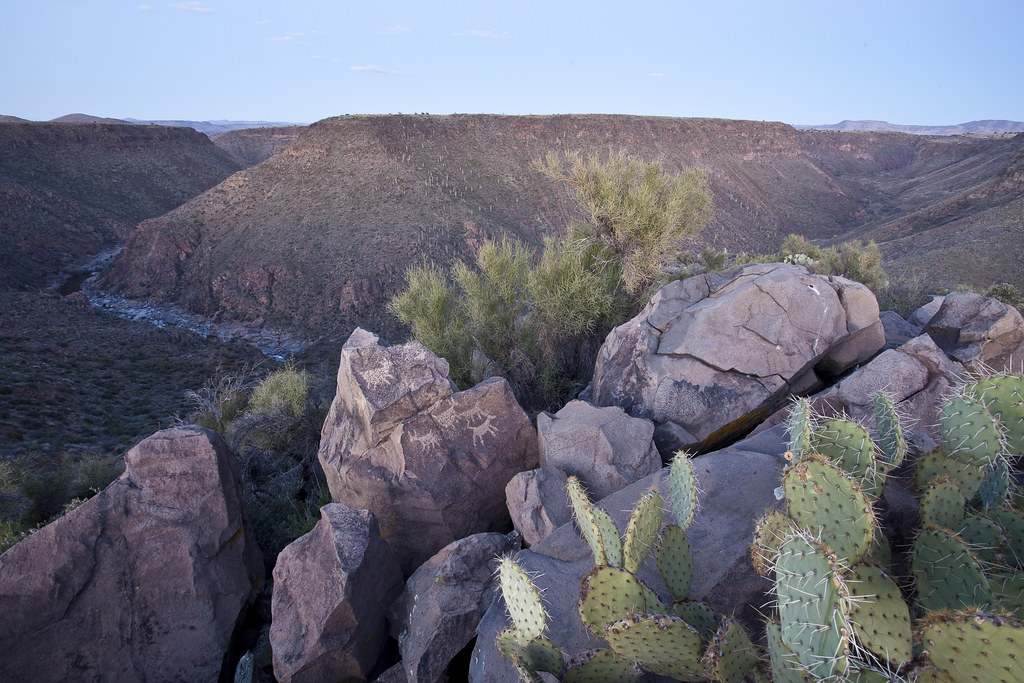
There is a moment, standing quietly on the boardwalk at Deer Valley Petroglyph Preserve, when the noise of modern Phoenix simply dissolves. The freeway hum fades. Your phone loses its grip on your attention. And then you see them — hundreds of ancient figures carved into dark basalt boulders, watching silently from a rocky hillside just north of the city. It is the kind of experience that reminds you, in the best possible way, how small and new you really are.
Deer Valley Petroglyph Preserve sits in the far north reaches of Phoenix, just off the I-17 near the Deer Valley Road exit. It is operated by Arizona State University and protects one of the largest and most significant concentrations of Native American rock art in the Sonoran Desert — more than 1,500 petroglyphs etched into the rocks over a span of roughly 5,000 years. The earliest images here were made by the Archaic people, long before the Hohokam civilization rose and fell in this same valley. Walking this site is not a metaphor for time travel. It is as close to the real thing as most of us will ever get.
The preserve is small by trail standards — the main loop is less than a mile — but do not let that fool you into rushing. The boardwalk and packed gravel path wind slowly past boulder after boulder, each one a canvas of spirals, human figures, animals, geometric patterns, and symbols that researchers are still working to fully understand. Some of the carvings are obvious and bold. Others require a patient eye and the right angle of morning light to reveal themselves. That quality of gradual discovery is part of what makes this place so compelling. You are never quite done looking.
The small visitor center at the entrance is genuinely worthwhile. The exhibits provide cultural context that deepens what you see on the trail — who these people were, how they likely created the carvings, and what archaeologists and Native scholars believe some of the imagery may represent. The staff are knowledgeable and enthusiastic, and the interpretive signage along the path adds to the experience without overwhelming it.
Early morning is the ideal time to visit, especially from October through April when temperatures are mild and the low desert light rakes dramatically across the rock faces, bringing the petroglyphs into sharp relief. Summer mornings work too, if you arrive right at opening. The site is shaded in parts and the loop is short enough to complete comfortably before the heat takes hold. Admission is modest — just a few dollars for adults — and parking is easy and free.
What makes Deer Valley feel different from other archaeological sites in the region is its intimacy. You are never far from the art. The boardwalk brings you genuinely close, close enough to appreciate the effort and intention behind each carved mark, without ever allowing visitors to touch or damage what has survived thousands of years. That respectful design philosophy keeps the experience feeling sacred rather than touristy.
If you have been to Pueblo Grande on the east side of town and loved it, Deer Valley will feel like a complementary chapter of the same long story. And if you have never explored Phoenix’s pre-Columbian past at all, this is one of the finest places in the entire Southwest to begin. Come curious, come slowly, and leave your earbuds in the car. The rocks have been waiting long enough — they deserve your full attention.