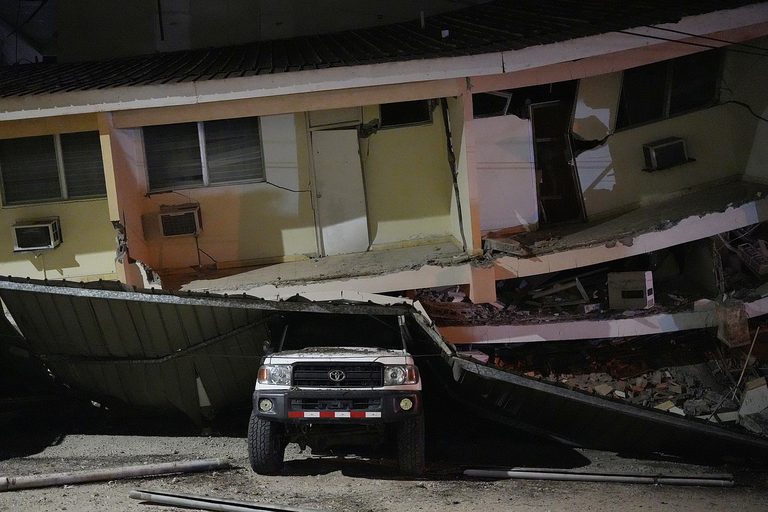
Panama City – President‑appointed Minister Juan Carlos Orillac announced Saturday that the nation is under a state of emergency after two powerful earthquakes struck the country on Friday. The quakes, measuring 7.7 and 6.6 on the Richter scale, caused widespread damage in all ten provinces and two Indigenous territories.
Aftershocks continue to shake communities
Seismologists recorded more than 100 aftershocks, including several in the 5.0‑range. The strongest aftershocks measured 5.8, 5.5 and 5.2 magnitude. The initial tremor was felt as far away as neighboring Colombia.
Damage assessment
The epicenter of the larger quake was located about six miles southwest of the remote community of Pitaloza Arriba in Herrera province, at a depth of six miles, according to the U.S. Geological Survey. The Civil Protection agency reported roughly 420 homes and a similar number of public schools damaged, along with seven hotels, at least 13 churches and nine bridges.
In the colonial‑era town of La Villa de Los Santos, about 40 miles northeast of the epicenter, a historic Catholic church collapsed. Residents, including 90‑year‑old Tony Jiménez, who described the shaking as “truly intense,” are sheltering in tents while awaiting further guidance.
Injuries and evacuations
Deputy director of the National Civil Protection System, Malitzie Rivera, said 27 people have been injured, ranging from minor to moderate. No deaths have been reported.
Rising sea levels and rough surf forced the evacuation of approximately 300 people from Isla Caña on the Pacific coast of Los Santos. In Penonomé, a shelter is housing 13 individuals, five of whom are children, after damage to the cathedral, the governor’s office and a local hotel.
Infrastructure impacts
One of Panama City’s water‑treatment plants operated at only 20% capacity on Saturday. Tent facilities with cots have been set up at six hospitals to accommodate displaced patients.
Tocumen International Airport, a major hub handling over 20 million passengers in 2025, briefly suspended operations after the first quake but resumed flights within hours. Travelers on regional airlines, including Copa Airlines, faced cancellations and delays.
Regional response
The Panama Canal Authority confirmed that canal operations continue normally, with safety inspections underway.
The United States Department of State deployed a disaster‑response team to assist with search and rescue, and pledged $5 million in humanitarian aid. U.S. Southern Command also delivered 2,000 pounds of food to affected communities via helicopters.
Why Panama fared better
Experts noted that Panama’s strict building codes, especially for high‑rise construction in the capital, likely limited casualties compared with recent deadly quakes in neighboring Venezuela and Colombia.
The last major earthquake to cause widespread damage in Panama occurred in 1991, when a 7.4‑magnitude quake centered in Costa Rica killed 23 people and left thousands homeless in the border region.
Panama sits on the Pacific “Ring of Fire,” where the Cocos, Nazca and Caribbean tectonic plates interact, making the region prone to seismic activity.
Original reporting: Texarkana Gazette — read the source article.