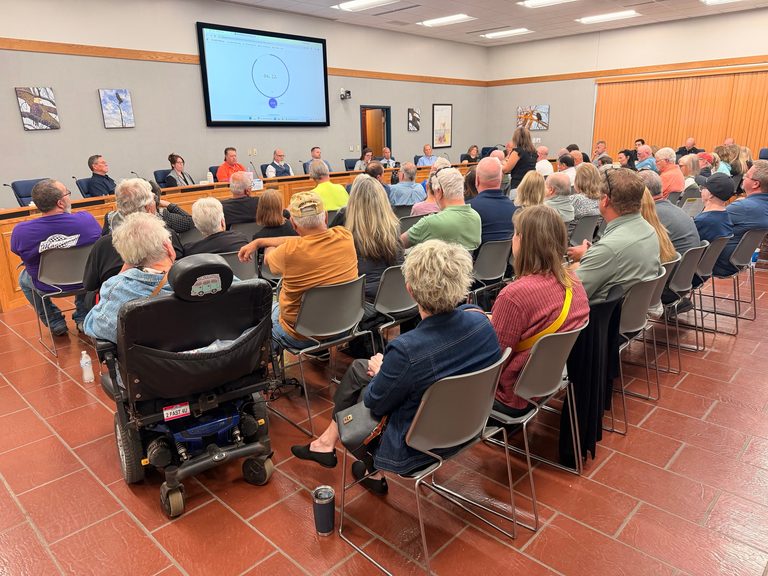
Oregon, Ohio – Residents of Oregon gathered at the city council chambers on Tuesday to debate Issue 25, a ballot measure that would ban any data center with a demand or peak load of 25 megawatts or greater. The measure, slated for a vote next week, has sparked a lively discussion among parents, educators, and community volunteers.
Economic arguments from local educators
Ben Pfeiffer, a science teacher at Clay High School with 28 years of service, warned that passing any new levy would be difficult in the current economic climate. “I think that we can agree that given the economic times we’re in, passing any kind of levy would be difficult. It doesn’t have to be this way,” he said.
Despite his caution, Pfeiffer highlighted the potential financial upside of the data‑center project. He noted that the commercial development is projected to bring more than $100 million to Oregon City Schools over 15 years, including $10 million in milestone payments over the next three to four years and $7 million annually through a pilot agreement. He added that, without the data center, the district would likely need to propose an operating levy in 2028, whereas the projected revenue could offset the operating deficit for eight to ten years.
Support from school staff on educational benefits
Melissa Mummert, an intervention specialist at Clay High School, echoed the sentiment that the data center could help preserve educational programs. “Our children are doing their part every day. Now we must do ours. We need to build an educational future defined by opportunity rather than program cuts and inspiration rather than reduced services,” she said.
Opposition voices raise financial and privacy concerns
Not all attendees were convinced. Laura Davis, a volunteer with United Neighbors of Oregon, likened the district’s planning strategy to “buying a car and hoping to make the payments when you win the lottery,” warning that there appears to be no contingency plan if the data center does not materialize.
Mary Crowley, another opponent, expressed worries about artificial intelligence, data security, and resource consumption. “We don’t want a data center. We don’t want unregulated AI. We don’t want surveillance technology. We don’t want our data being stolen and used against us. We don’t want our resources exhausted,” she said.
Community urged to research before voting
Both sides encouraged voters to educate themselves on data‑center operations and the implications of the ban before casting their ballots. The council meeting provided a forum for residents to ask questions and hear directly from educators and community advocates.
What’s next?
Issue 25 will appear on the ballot in the upcoming municipal election. Voters will decide whether to prohibit large‑scale data‑center projects within the city limits, a decision that could shape the district’s financial outlook and the community’s approach to emerging technologies.
Original reporting: 13abc WTVG Toledo (news) — read the source article.