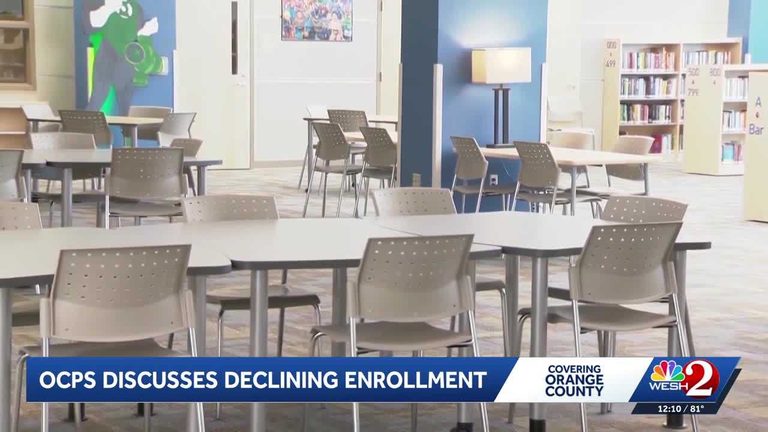
Orange County Public Schools officials are confronting a sharp drop in student enrollment that now leaves roughly 37,000 seats empty across the district. The board is actively discussing creative alternatives to school closures, emphasizing the importance of preserving elementary schools as vital neighborhood anchors.
Enrollment pressures and community impact
Board member Stephanie Vanos explained that many of the district’s 48 elementary schools have fewer than 500 students. While a couple of schools remain near capacity, the majority are seeing numbers well below historic levels. Vanos linked the decline to several factors that the board believes are beyond its immediate control, including lower birth rates, recent immigration‑policy changes, housing‑affordability challenges and the growth of school‑choice programs.
“It’s difficult to close elementary schools because they really are a neighborhood hub. They’re really an important part of the community, not just for academics, but for many reasons,” Vanos said. “We’re trying to think about how we can reconfigure our schools to help preserve as many of them as we possibly can.”
Alternative models under consideration
The board’s recent work session explored a range of structural options. One proposal would extend the traditional K‑5 model to K‑6, while another would create K‑8 campuses that keep younger students together with older peers. A more radical idea would split two nearby elementary schools into a pre‑K‑through‑third‑grade campus and a fourth‑through‑eighth‑grade campus, allowing resources to be concentrated where they are most needed.
Vanos also raised the possibility of a combined junior‑high and high‑school configuration, suggesting a “seventh‑to‑twelfth‑grade” model that could streamline staffing and facilities use. In addition, the board is looking at adjusting school start times at select campuses to better align with transportation logistics and family schedules.
Budget implications and upcoming decisions
Enrollment numbers directly affect the district’s budget, and the board acknowledges that lower student counts reduce state funding. Vanos noted that the recent passage of Amendment 3 – a measure that will impact before‑and‑after‑school care, summer programs and school‑resource officers – adds another layer of complexity to budgeting and safety planning.
“I do think it will necessitate another conversation about security, and it will be another round of really difficult decisions,” Vanos said, underscoring the board’s commitment to maintaining safe learning environments while navigating fiscal constraints.
Looking ahead
The board emphasized that any school closures would be a last resort. Instead, officials are focused on preserving as many neighborhood schools as possible through re‑configuration, shared services and flexible scheduling. Community members are encouraged to stay engaged, attend upcoming board meetings and provide input on the proposed models.
By exploring these alternatives, Orange County aims to protect the fabric of its neighborhoods, keep families close to their local schools and ensure that educators have the resources they need to deliver a strong, values‑based education.
Original reporting: WESH Orlando — read the source article.