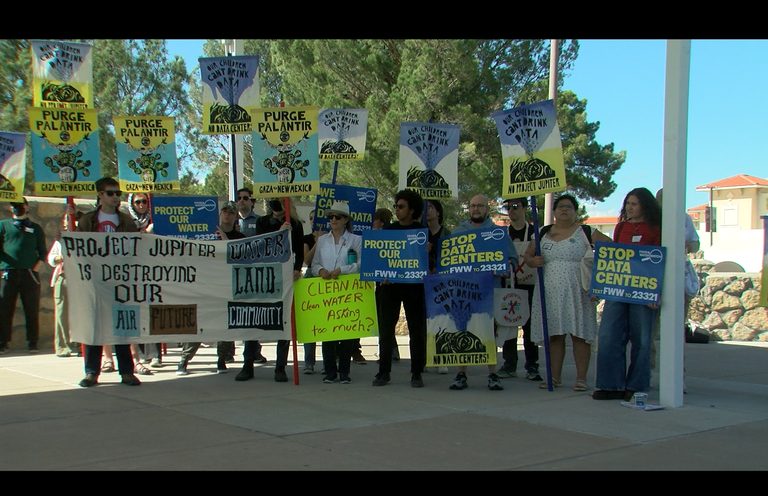
LAS CRUCES, N.M. – On Oct. 25, a crowd of activists from across New Mexico and other states assembled at New Mexico State University to voice concerns about Oracle’s proposed “Project Jupiter” data center in Doña Ana County. Organized by Youth United for Climate Crisis Action (YUCCA) and the “Stop Project Jupiter” coalition, the rally featured six speakers who warned of potential impacts on air quality, water security and the desert ecosystem.
Local worries and generational concerns
Long‑time resident Judith, who has lived in the county for more than four decades, described the plan as “terrifying on every level” and warned that the project could jeopardize the community’s water supply. Organizer Jonathan Juarez urged a pause on artificial intelligence infrastructure to preserve clean air and water for future generations.
Oracle’s environmental response
In a detailed statement, Oracle emphasized its commitment to responsible development. The company said it has replaced the original gas‑turbine design with Bloom Energy fuel cells, a move that “significantly reduces local air pollutants” and “minimizes operational water use.” Oracle also announced an enforceable operating cap that would cut the microgrid’s emissions by roughly 35 percent compared with the earlier proposal.
Oracle further outlined a request for proposals to secure two gigawatts of new renewable energy in New Mexico, including solar, wind and geothermal projects, with the goal of achieving 100 % carbon‑free matching for Project Jupiter by 2031—well ahead of the state’s 2045 renewable‑energy target.
Water‑use safeguards
The company described its cooling and fuel‑cell systems as “closed‑loop,” noting that the estimated average annual water use for these systems is comparable to the consumption of about nine U.S. households. Public drinking water, Oracle said, would be limited to everyday workplace needs such as kitchens and restrooms, and the firm has launched an initiative to save more water than the project consumes.
Economic impact and community partnerships
Oracle highlighted the projected economic benefits of the data center, citing more than $100 million in state and county tax revenue already generated, including $50 million earmarked for local water infrastructure. To date, the project has employed 4,393 workers, 1,230 of whom are New Mexico residents, and forecasts over $13 billion in long‑term economic impact, 7,000 construction jobs and 1,500 ongoing positions.
The company also noted philanthropic partnerships with local organizations such as Casa de Peregrinos, Roadrunner Food Bank, the Community Foundation of Southern New Mexico and the Moms on Board group, which is helping develop Dino Dig Park.
Activist perspective
Protest speakers questioned the promises of prosperity that often accompany large tech projects in rural areas, recalling past experiences where corporations arrived with job promises only to leave communities behind. While the activists’ concerns reflect genuine apprehension about resource‑intensive AI infrastructure in the Chihuahuan Desert, Oracle’s statement provides concrete mitigation steps and a transparent dashboard to monitor air, noise, heat, light and water performance once the facility becomes operational.
What’s next?
The dialogue between Oracle and local stakeholders is ongoing. The company pledged to continue listening, sharing information and working with the community to deliver a responsible project for southern New Mexico. The upcoming public dashboard will give residents real‑time visibility into the facility’s environmental performance, offering a measure of accountability that many activists have called for.
Original reporting: El Paso News (HLL/CB) — read the source article.