By Eric Thompson
Submitted by: Eric Thompson
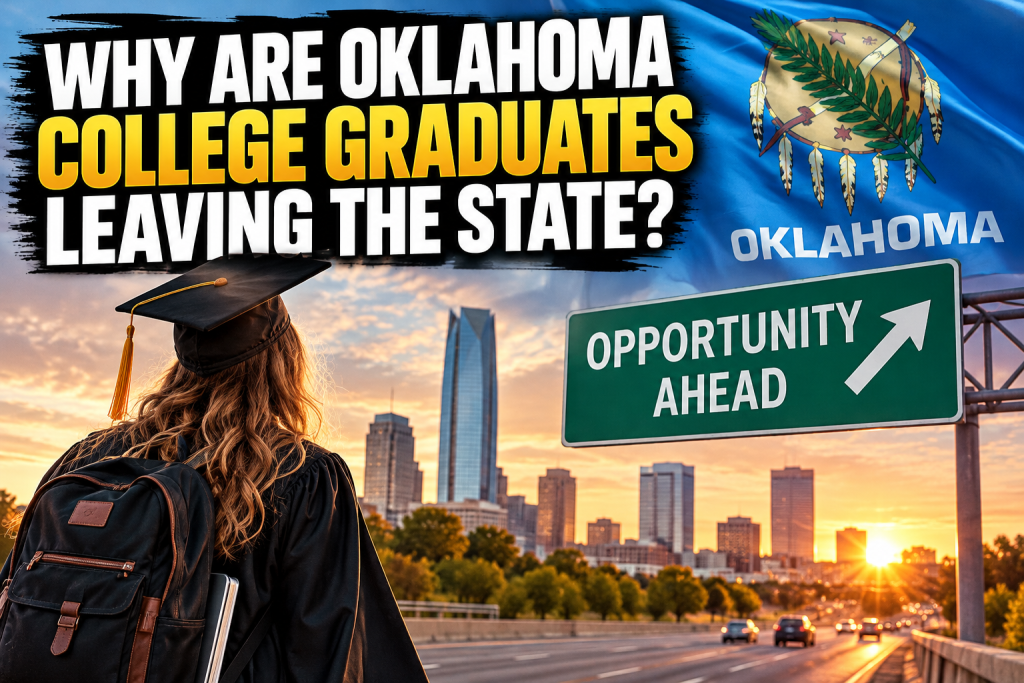
A newly released report reveals that Oklahoma is retaining a declining percentage of its college graduates. As the state competes for jobs, businesses, and investment, the numbers raise important questions about economic opportunity and the future of Oklahoma’s workforce.
Oklahoma invests millions of dollars each year in educating its next generation of workers, entrepreneurs, teachers, nurses, and engineers. But a troubling new report suggests that an increasing share of college graduates are building their careers somewhere else.
According to the Oklahoma State Regents for Higher Education’s 2025 Employment Outcomes Report, released October 26, just 76.5% of graduates from Oklahoma public colleges and universities were working in the state one year after graduation.
That figure represents a substantial decline from 83% in the previous report and 87% in the report before that.
The trend becomes even more concerning when examining graduates several years into their careers.
Five years after graduation, approximately 70.8% remained employed in Oklahoma. After ten years, that percentage dropped to 65.8%.
For a state that promotes its business-friendly environment, affordable living, and commitment to economic development, these figures deserve serious attention.
Oklahoma is producing educated workers. The question is whether the state’s economy is creating enough opportunities to keep them.
The numbers tell an important story
The report includes graduates across different degree levels and fields of study.
It also distinguishes between graduates who were Oklahoma residents before attending college and those who came from elsewhere.
Among graduates who were already Oklahoma residents, approximately 87.5% remained employed in the state one year after graduation.
After five years, that figure declined to 81%. After ten years, approximately 75% remained.
Those numbers suggest that graduates with established Oklahoma roots are more likely to remain than the broader graduate population.
That’s understandable.
Family connections, community relationships, homeownership, and familiarity with the region can influence where someone chooses to live.
But even Oklahoma-born graduates eventually leave.
For state leaders, that raises an important economic question: Are talented young professionals finding enough opportunities to build successful long-term careers without relocating?
The report measures employment outcomes rather than documenting each graduate’s personal reasons for leaving. It should therefore be treated as evidence of a retention problem, not proof of any single cause.
Huge savings on cell phone service:
Oklahoma’s technology workforce faces particular challenges
Some of the most significant concerns involve science, technology, engineering, and mathematics.
According to the report, approximately 73% of Oklahoma STEM graduates remained employed in the state one year after graduation.
Five years later, retention dropped to 63.6%.
After ten years, only 59.6% remained.
These professions are particularly important because they support industries that generate innovation, productivity, and higher-paying employment opportunities.
Technology companies, aerospace manufacturers, engineering firms, healthcare organizations, and advanced manufacturing businesses all depend on specialized workers.
When experienced professionals relocate, Oklahoma potentially loses more than an individual employee.
It can lose future entrepreneurs, business founders, mentors, taxpayers, and community leaders.
That does not mean every graduate who leaves represents a permanent loss. Some return later with valuable experience and professional connections.
Nevertheless, declining retention rates should encourage Oklahoma to evaluate its economic competitiveness.
Nurses and teachers show stronger retention
Not every profession is experiencing the same pattern.
Nursing graduates demonstrate comparatively strong employment retention.
Approximately 89% were employed in Oklahoma one year after graduation, followed by 81% after five years and 76% after ten years.
Among graduates completing bachelor’s degrees in teaching, approximately 85% remained after one year and 77.3% after five years.
These figures suggest that employment opportunities and career structures may influence whether graduates remain.
However, the data alone cannot establish why particular professions retain more workers.
Understanding those differences could help state officials identify which economic policies and workforce partnerships are producing the strongest results.
Is Oklahoma doing enough to attract high-paying jobs?
From a conservative economic perspective, sustainable prosperity begins with a healthy private sector.
Government cannot manufacture long-term economic success simply by announcing new programs or distributing incentives.
Businesses must have compelling reasons to invest, expand, and hire.
Oklahoma has several advantages worth promoting, including its central location, established energy industry, aerospace sector, and comparatively affordable communities.
But employers must also compete for talent.
A young engineer or software developer evaluating job offers may consider salary, career advancement, professional development, housing, and quality of life.
If another state offers substantially better opportunities, personal ties to Oklahoma may not be enough to keep that graduate here.
The answer should not automatically be another government spending program.
Instead, lawmakers should examine whether taxes, regulations, infrastructure limitations, and workforce shortages are discouraging private investment.
They should also evaluate whether existing economic development incentives are producing measurable results.
Taxpayer-funded incentives should be judged by actual employment, wages, and long-term economic activity rather than optimistic projections.
What this means for Broken Arrow and Tulsa
The Tulsa metropolitan area has an opportunity to benefit from Oklahoma’s educated workforce.
Broken Arrow’s continued development, combined with Tulsa’s aerospace, healthcare, manufacturing, and technology industries, provides a foundation for future growth.
But attracting new businesses is only part of the equation.
Communities must also create environments where young professionals want to establish families, purchase homes, and build careers.
That includes dependable infrastructure, safe neighborhoods, good schools, reasonable housing costs, and access to recreation and entertainment.
Local employers can strengthen their recruiting efforts by partnering with Oklahoma colleges and universities.
Internships, apprenticeships, mentoring programs, and early career opportunities may help students develop professional connections before graduation.
Businesses that identify promising students early may have an advantage when those graduates begin searching for full-time employment.
Education should connect to actual workforce demand
Universities also have responsibilities.
Higher education should prepare students for meaningful careers while preserving academic freedom and intellectual development.
Students deserve accurate information about employment opportunities, expected earnings, and the financial implications of different degree programs.
State leaders should encourage greater cooperation between educational institutions and employers.
That does not mean every degree must lead directly to one specific occupation.
It means students should have enough information to make responsible educational and financial decisions.
Taxpayers also deserve to know whether public investments in higher education are producing measurable benefits for Oklahoma’s economy.
The bigger picture
Oklahoma cannot force graduates to remain, nor should it attempt to restrict their freedom to pursue opportunities elsewhere.
A free society allows individuals to make decisions based on their personal goals and circumstances.
The state’s responsibility is to create conditions that make remaining an attractive choice.
That means encouraging entrepreneurship, reducing unnecessary barriers to business growth, supporting competitive industries, and maintaining communities where families can prosper.
Oklahoma’s future will depend partly on whether its young professionals see opportunity at home.
The goal should not be to prevent graduates from leaving. It should be to make Oklahoma a place they genuinely want to stay.
Sources
Oklahoma Voice — Oklahoma retains declining share of its college graduates
Oklahoma Voice
Oklahoma State Regents for Higher Education — 2025 Employment Outcomes Report
SEO keywords: Oklahoma college graduates, Oklahoma brain drain, Oklahoma workforce 2026, Tulsa employment opportunities, Broken Arrow economic development, Oklahoma STEM jobs, Oklahoma higher education, college graduate retention, Oklahoma economic growth, Oklahoma business news.