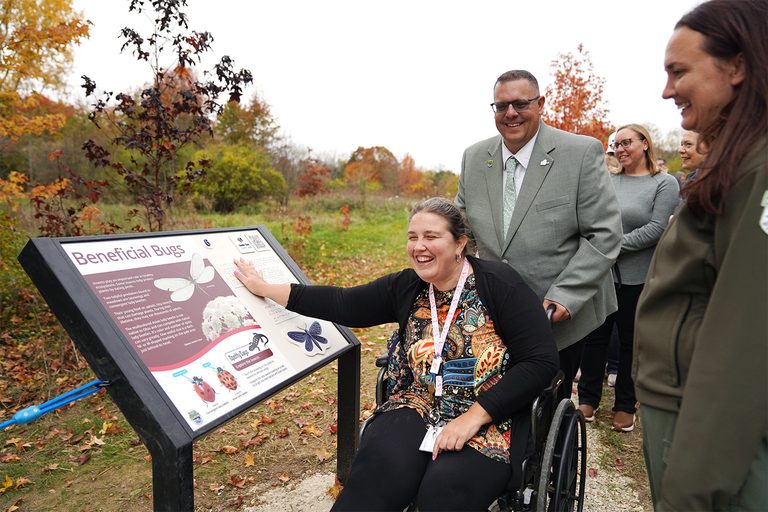
Portage County – In early November, Wingfoot Lake State Park opened Ohio’s first Braille trail, a quarter‑mile path designed to let individuals with low vision explore nature through touch, sound and scent. The trail includes raised Braille cells on each informational board, QR‑code audio guides and tactile guide cords that lead hikers from one station to the next.
Vision‑impaired community leads the way
James Warnken, a legally blind accessibility consultant from Canton, has been testing the trail since its debut. Warnken lost most of his vision at age nine but still uses peripheral sight to detect shapes and colors. He said, “Anything that can be done to make things more accessible – a park, a restaurant, an event – the disabled community is always excited to hear about those innovations.”
Warnken, who often walks with his dogs or his wife’s descriptive narration, praised the guide cords for allowing him to navigate without relying on another person. “It will be nice to see these kinds of trails go up to where I don’t always have to ask or rely on somebody else,” he explained.
How the trail works
The trail begins at a wooden post marked “Braille Trail,” with the words transcribed in Braille beneath the sign. Seven informational stations line the path, each offering a tactile cut‑out of a local creature – the first board features Spotty, a black salamander with yellow spots. Visitors can feel the raised shape as they approach, then scan a QR code for an audio description of the animal and its habitat.
Content on the boards can be swapped seasonally, covering topics such as monarch butterflies, white‑tailed deer and other regional wildlife. Park manager Mike Studeny said the flexibility allows the trail to stay fresh and educational year after year.
Funding and future improvements
The Ohio Department of Natural Resources received a $25,000 grant from Portage Developmental Disabilities, which covered most of the materials and signage. A separate $50,000 grant will add a shaded play area and swings nearby.
Construction began in September, and Studeny noted that creating a first‑of‑its‑kind amenity required a learning curve. “There’s a lot of things that you have to learn, working through it, figuring out what works and how you do it. We now have the blueprint for other parks to follow,” he said.
After his first lap, Warnken offered constructive feedback, noting that some Braille cells felt less raised than others. He acknowledged criticism but remained optimistic: “There’s a lot of concern of backlash of ‘You didn’t think of this, you didn’t do that,’ but I think it’s generally pretty positive feedback just to see people challenging and trying to do better and provide more access at parks.”
Broader accessibility at Wingfoot Lake
The Braille trail adds to a suite of ADA‑compliant facilities already at Wingfoot Lake State Park, including accessible restrooms, kayak launches, playgrounds, sensory trails and a fishing pier. Once the ODNR and the park incorporate additional feedback from Warnken and other vision‑impaired visitors, the trail will be refined further.
For families, seniors and anyone who loves the outdoors, the new Braille trail offers a richer, more inclusive way to experience Ohio’s natural beauty.
Original reporting: Signal Akron — read the source article.