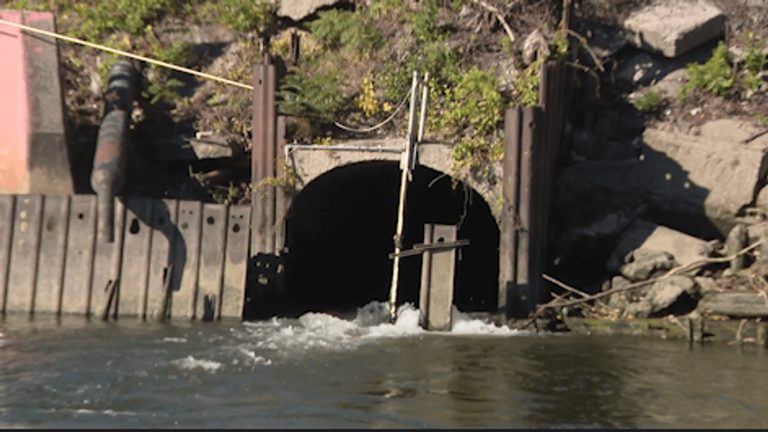
The Office of General Services (OGS), which operates the Empire State Plaza’s cooling system, has formally requested that the New York Department of Environmental Conservation (DEC) allow a higher water‑temperature limit for its Hudson River discharge during the warm season. OGS wants the limit raised from 90 degrees Fahrenheit to 100 degrees Fahrenheit from May through October, while keeping the 90‑degree cap for the rest of the year.
OGS argues that its internal research shows the hotter water will remain localized near the discharge point and will not harm the river’s aquatic community. The agency’s 400‑page submission cites river‑temperature measurements, computer modeling, biological surveys and historic fish‑monitoring data. It notes that the hottest water stays near the surface and close to the bank, leaving deeper, cooler zones for fish passage. A 2024 field survey cited in the report found similar plankton and bottom‑dwelling organism communities inside and outside the heated plume, though it did not directly sample fish.
Environmental groups raise concerns
Riverkeeper, a Hudson River advocacy organization, is skeptical. Legal program director Mike Dulong warned that the discharge could intersect the migration path of American shad, a species still recovering from decades of decline. “Eggs and larvae are likely to pass this discharge on their way downstream,” Dulong told CBS6.
Riverkeeper is calling for a dedicated biological survey of the plume’s impact on shad and other fish, emphasizing that heated water could add another obstacle to the species’ recovery.
Expert perspective
Professor Karin Limburg of SUNY College of Environmental Science and Forestry, who has studied the Hudson and shad for years, offered a cautious view. She noted that the river’s volume may help dilute the heated water, but warned that rising river temperatures overall reduce dissolved oxygen, increasing stress on fish over time.
OGS’s own data show that average annual water temperatures at Albany have risen about 2.7 degrees Fahrenheit between 2003 and 2024. The agency’s analysis projects continued warming over the next five years but maintains that the proposed discharge limits would not cause appreciable harm.
DEC response and next steps
The DEC said it has thoroughly reviewed OGS’s studies and found that temperature effects appear localized near the riverbank. The agency is currently accepting public and stakeholder comments and has not set a timeline for a final decision.
Riverkeeper also urged consideration of alternative cooling methods, such as a closed‑cycle system that reuses water or a diffuser array to better mix the heated discharge. OGS evaluated options like cooling towers, a diffuser array and a cooling pond but deemed them impractical due to scale, operational constraints and peak‑summer river temperatures.
OGS continues to invest in improvements, including a new electric chiller designed to lower discharge temperatures during extreme heat.
Original reporting: CBS 6 WRGB Albany (local) — read the source article.