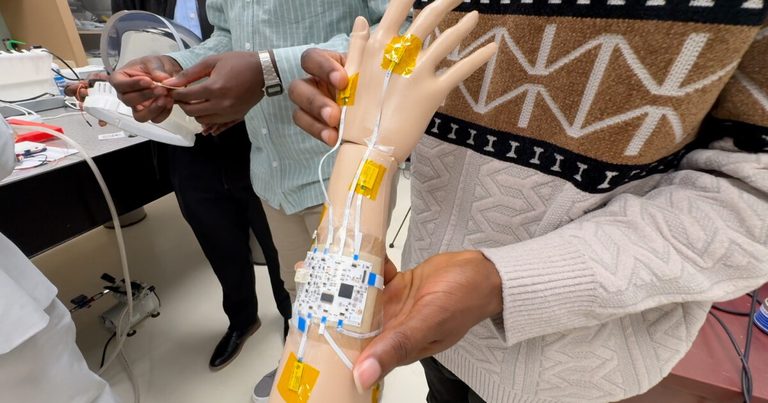
Norfolk, Va. – Engineers at Norfolk State University are turning a simple medical dressing into a high‑tech health tool. Led by associate professor Dr. Renny Edwin Fernandez, the team has developed a prototype smart bandage that continuously measures wound conditions and uses machine‑learning algorithms to predict healing progress.
How the bandage works
The prototype incorporates eight miniature sensors that track temperature, humidity and gas resistance beneath the dressing. Data are processed by an on‑board micro‑controller and transmitted via Bluetooth to a smartphone or other display. Graduate student Santhosh Adhinarayanan explained that the system can “think” about the data, offering predictions about whether a wound is healing properly and how long recovery may take.
Swarm intelligence for better insight
What sets the project apart is its use of swarm intelligence. Multiple bandages can communicate with each other, creating a network that shares information across a patient’s wounds. Doctoral student Harikrishnan Muraleedharann Jalajamony said this collaborative approach could give clinicians a more comprehensive view of a patient’s recovery.
Practical considerations
Team member Soumadeep De noted that the current prototype runs for roughly 57 to 60 hours on a single charge, a duration he believes is practical for most treatment plans. The bandage is also designed to be modular; researchers can swap sensors as new capabilities—such as pH or cortisol measurement—become available.
Potential impact for patients
Beyond hospital use, the technology could empower patients to monitor wounds at home, alerting them when professional care is needed. This is especially promising for individuals with diabetes, who often experience nerve damage that reduces pain perception and can lead to unnoticed wound complications.
Path to commercialization
During the summer of 2026, the team secured $50,000 from the National Science Foundation’s I‑Corps program to explore commercial pathways. Researchers traveled nationwide, conducting more than 100 interviews with doctors, nurses and wound‑care specialists to gauge market needs and address concerns about placing electronics on a wound.
Adhinarayanan emphasized that building trust will be crucial: “Nobody wants to put electronics on their wound if they are not used to it,” he said. The team is also collaborating with Norfolk State’s nursing department, testing the system on medical mannequins to refine usability.
Educational benefits
The project provides hands‑on experience for undergraduate, master’s and doctoral students, who have designed flexible circuit boards, developed embedded systems and built functional prototypes. Participants include Samuel Kwawukume, Charles Gaba, Solomon Adjokatcher, Daniel Brookman and Justin Patrice.
For the researchers, seeing a Norfolk‑made device potentially improve patient outcomes is a source of pride. “Definitely, this kind of technology will be in the future,” Adhinarayanan said, expressing optimism that the smart bandage will one day be a standard tool in hospitals and home care settings.
Original reporting: WTKR News 3 (Scripps) – local — read the source article.