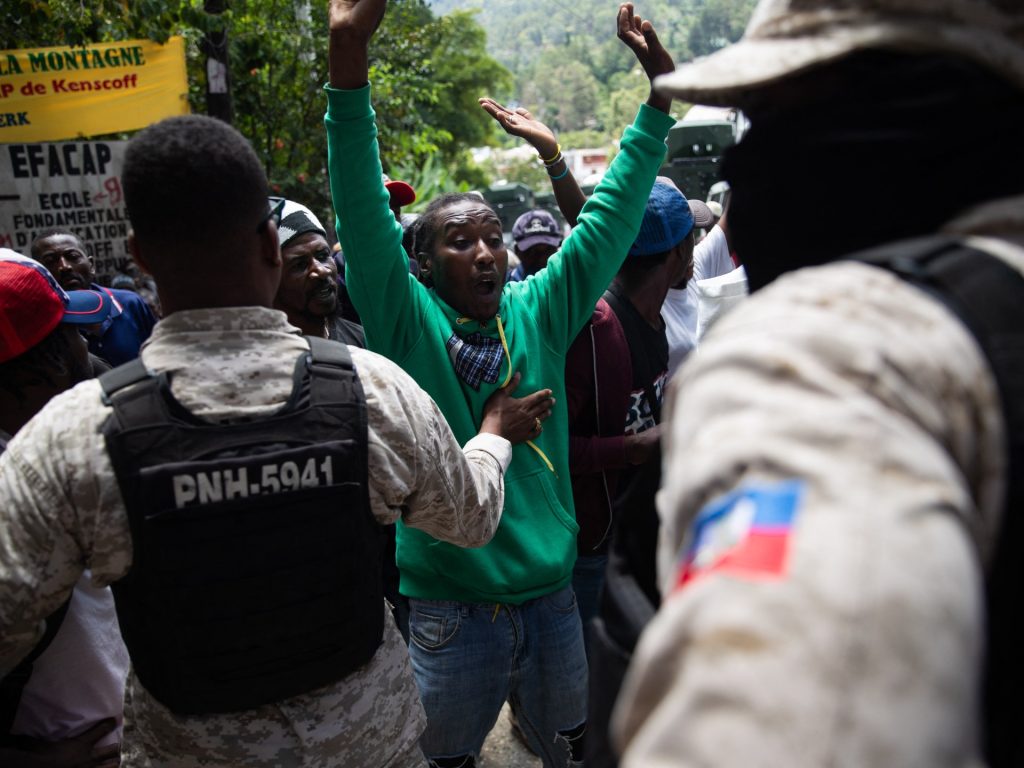
KENSCoff, Haiti — A mountainous community once regarded as a refuge from the violence consuming Haiti’s capital became the scene of another horrific massacre Sunday night, as heavily armed gang members descended on Kenscoff, killing civilians, burning homes and attacking a church compound where displaced families had sought safety.
The assault began during the night of August 23 and continued into the early hours of August 24. Members of the powerful Viv Ansanm gang coalition attacked several areas of Kenscoff, a farming community in the hills overlooking Port-au-Prince.
What followed was described by Kenscoff Mayor Massillon Jean simply as a “night of terror.”
The precise number of people killed remains uncertain. Haitian authorities have formally confirmed at least 25 deaths, while United Nations reporting has placed the death toll as high as 47, with 22 others wounded. The discrepancy reflects the extraordinary difficulty authorities face reaching victims, locating the missing and recovering bodies in territory threatened by armed gangs.
More than 50 people were also reportedly kidnapped, making the assault one of Haiti’s largest mass abductions in recent years.
A Church Became a Killing Ground
Among the most disturbing scenes unfolded at a church compound that had been sheltering Haitians already displaced by earlier violence.
According to the United Nations, approximately 22 victims were reportedly executed inside the church compound after seeking refuge there. The church has been identified in reports as the Church of the Ark of the New Covenant, an evangelical Christian congregation near Kenscoff’s municipal cemetery.
The congregation was more than simply a place of Sunday worship. It had provided shelter and assistance to people fleeing violence elsewhere and worked with humanitarian organizations on food assistance, medical clinics, pastoral training and other community programs.
The very place people turned to for sanctuary became a target.
Gang members reportedly stormed the displaced-persons site, killing some victims execution-style, wounding others and abducting an unknown number before withdrawing.
Mayor Jean said searches for victims continued after daylight revealed the scale of the destruction.
Homes Burned, Livestock Killed
The violence was not confined to the church.
Armed attackers moved through the surrounding community, setting fire to homes and other structures. Reports indicate at least 25 homes were burned. Animals were deliberately killed as well, including horses and other livestock.
In a rural farming community, killing livestock inflicts another kind of devastation. These animals are property, transportation, agricultural resources and, for many families, part of their livelihood.
By Monday morning, survivors were searching for relatives while bodies remained in the streets and burned buildings marked the path of the attackers. Some families discovered that several generations of relatives had been killed or taken.
The attack left still more Haitians displaced — people who had already fled violence once again forced to abandon whatever shelter they had found.
Viv Ansanm’s Expanding Campaign
The massacre is the latest evidence of the expanding reach of Viv Ansanm, a coalition of Haitian gangs that has become one of the country’s most powerful armed forces.
The United States formally designated Viv Ansanm a Foreign Terrorist Organization in May 2025. The designation recognized that the organization had moved beyond ordinary street crime into a heavily armed network capable of destabilizing the Haitian state.
Kenscoff is particularly significant.
For years, the mountain community was known for its cooler climate, farms and relative tranquility compared with Port-au-Prince below. But beginning in 2025, armed groups increasingly pushed into the region. Kenscoff has since endured repeated attacks involving murder, kidnapping, rape and arson.
The violence illustrates a larger problem confronting Haiti: gangs are no longer merely fighting over neighborhoods within Port-au-Prince. They are expanding outward, attacking communities that once served as places of refuge.
An estimated 1.5 million Haitians are now internally displaced by the country’s violence and instability.
That creates a terrible cycle. Families flee one gang-controlled neighborhood only to discover that the violence has followed them to the community where they sought safety.
A Government Struggling to Protect Its People
Haiti’s government condemned the Kenscoff massacre and announced that additional security forces would be deployed to the area.
Residents, however, are demanding more than promises.
The proximity of some of the killings to government and police facilities has fueled anger among residents who question how armed gangs could carry out such an extensive attack without being stopped. Some have called for changes in police leadership and stronger action against the gangs.
Haiti’s National Police, military and international security forces face an enormous challenge. Armed organizations control or contest large portions of Port-au-Prince, while the violence continues spreading into surrounding communities.
And behind every statistic is a family.
A farmer who loses relatives.
Parents searching for kidnapped children.
Families standing beside the remains of burned homes.
Christians who sought protection inside a church only to find armed men coming through its doors.
A Nation Desperate for Peace
The attack in Kenscoff should not disappear into the seemingly endless stream of reports about violence in Haiti.
The people murdered Sunday night were not combatants in a war. Many were ordinary Haitians attempting to survive one.
Some had already been driven from their homes. They gathered in a church because it represented what churches have represented for generations — sanctuary, community and hope.
Instead, armed men turned that sanctuary into a killing ground.
Whether the final death toll proves to be 25, 40, 47 or higher does not change the fundamental truth of what happened in the mountains above Port-au-Prince.
Innocent people were hunted. Families were shattered. Homes were burned. Livestock and livelihoods were destroyed. Men, women and children were kidnapped.
And a church sheltering people who had nowhere else to go was attacked.
For the people of Kenscoff, August 23 will be remembered not simply as another episode in Haiti’s security crisis, but as a night when terror came directly into their homes, their farms and their place of worship.
The world should remember them — and it should not become accustomed to their suffering.