New London, CT – The Garde Arts Center’s storefront at 305 State Street now displays “We Live Here,” a collaborative exhibition that explores the city’s housing history and envisions future solutions. The exhibit, which runs through December 18, was shaped by a 30‑member citizens’ advisory board that includes tenants, activists, city officials and other stakeholders.
Community‑Driven Design
Curator Anna Vallye, an assistant professor at Connecticut College, co‑directed the project with Beth Sabilia, director of the Center for Housing Opportunity of Eastern Connecticut. Both say the advisory board’s input guided everything from the layout—styled like a construction site—to the choice of a downtown location where any passerby can encounter the work.
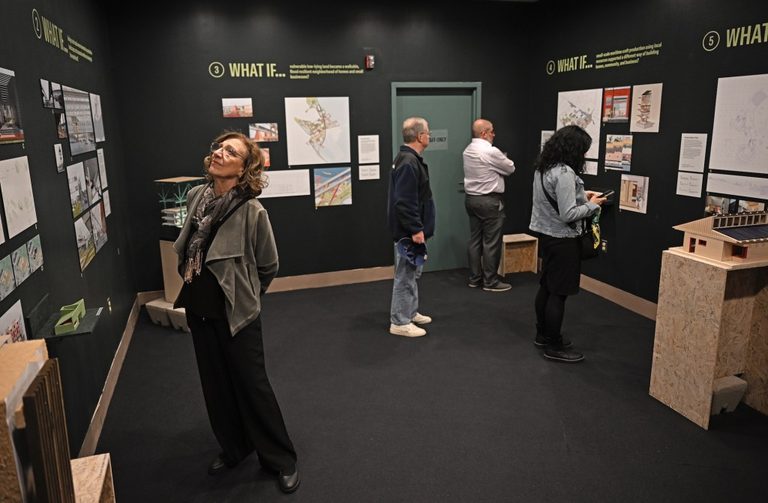
Inside, visitors walk past plywood hoarding, forest‑green walls that echo local high‑school colors, and a timeline that serves as the exhibit’s “spine.” The timeline links national housing trends to New London’s own development, allowing guests to see how broader policies have shaped local neighborhoods.
Historical Context and Personal Stories
The exhibit opens with early photographs, including Jacob Riis’s “How the Other Half Lives,” which inspired progressive reformers in the late 1800s. Archival political cartoons, redlining maps, and campaign‑ad clippings illustrate how exclusionary zoning and discriminatory policies have limited housing options for many residents.
One postcard‑style comment from a visitor calls for “modest homes,” echoing a desire for smaller, more efficient housing. Another highlights that Black veterans were denied benefits from the GI Bill, a reminder of past inequities that still affect today’s affordability crisis.
Data, Visuals and Interactive Elements
Data visualizations document the dominance of single‑family homes in Connecticut and the impact of restrictive land‑use rules. An interactive map lets visitors place a yellow pin for single‑family homes or an orange pin for multi‑family housing, showing the current housing mix across the New London metropolitan area.
Throughout the space, handwritten postcards from community members add personal insight, and a looped video series—produced by Connecticut College students—features residents speaking directly to the camera about their housing experiences.
Speculative Designs for a Better Future
Beyond the historical narrative, the exhibit presents speculative designs for New London’s future. Architectural models built from salvaged oyster‑shell bricks suggest ways to repurpose underused lots, transform decommissioned highway decks into market stalls, and create flood‑resistant modular housing with shared catwalks.
Student concepts from Yale’s School of Architecture envision co‑created, shared‑living alternatives that prioritize community over profit. A design‑athon encourages residents to propose their own zoning and building regulations, pushing back against top‑down decision‑making.
Programming and Community Engagement
The exhibition is more than a visual display. It has hosted a block party, organizer trainings by the Connecticut Tenants Union, and panels on recent housing legislation in Hartford. This month, the Southeastern Connecticut Community Land Trust will hold a two‑part film screening on alternative economies, and The Day newspaper will stage a housing‑equity forum at Connecticut College on December 1.
“We all live somewhere,” Vallye says. “Whether we’ve lived here for months or generations, organizing at the local level can make a real difference.” The exhibit’s portraits—featuring a pastor and his partner, a local couple with their garden, and a Navy veteran who returned home after two tours— underscore the personal stakes behind housing policy.
Visit the Exhibit
“We Live Here/New London” is on view at the Garde Gallery, 305 State Street, through December 18. For more information, visit the Garde Arts Center website.
Original reporting: The Connecticut Mirror — read the source article.