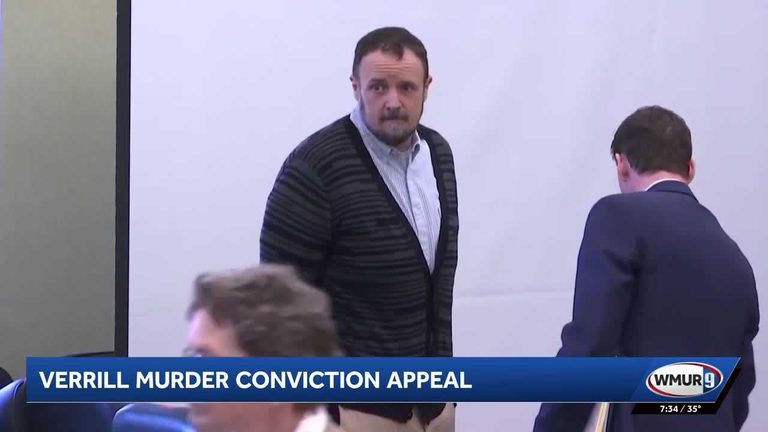
The New Hampshire Supreme Court convened on Tuesday to consider an appeal by Timothy Verrill, who is serving a 90‑year‑to‑life sentence for the 2017 murders of Christine Sullivan and Jenna Pellegrini. The appeal challenges the sufficiency of the evidence that led to his conviction.
Defense arguments
Defense attorney Stephanie Hausman opened the hearing by asserting that the prosecution’s case was insufficient to prove murder beyond a reasonable doubt. “There is no video confession, and no DNA from Mr. Verrill was found on the victims,” Hausman said. She also contended that a key witness who testified at the first trial should have been excluded because the defense was denied a chance to cross‑examine the witness before a mistrial was declared. That witness died before the second trial began.
Hausman emphasized that the burden on appeal is to show that the evidence does not exclude all reasonable conclusions consistent with innocence. She argued that the state has not met that burden, noting the lack of direct forensic links to Verrill.
Prosecution response
Senior Assistant Attorney General Peter Hinckley countered that the totality of the evidence supports Verrill’s guilt. He highlighted security‑camera footage that captured Verrill at the residence on the night of the killings before the camera went dark for several hours, making him the only other person seen with the victims. Hinckley also pointed to DNA found on garbage bags at the home, linking Verrill to the crime scene.
“The evidence shows the defendant had the means, motive, opportunity, and intent to commit the murders, and he demonstrated a consciousness of guilt after the fact,” Hinckley said. He noted that prosecutors had presented evidence of Verrill’s declining mental health and drug abuse, but argued these factors did not excuse the violent acts.
Legal context
The appeal focuses on whether the trial court erred in admitting certain testimony and whether the evidence presented at trial was sufficient to support a murder conviction. Under New Hampshire law, an appellate court reviews the record for legal errors and may overturn a conviction if it finds that the evidence was insufficient as a matter of law.
Both sides acknowledged that the case could take months to resolve, as the justices will consider the arguments and issue a written opinion later in the year.
Potential impact
If the Supreme Court were to overturn Verrill’s convictions, the case would likely be remanded for a new trial, extending the legal process for the victims’ families and the community. Conversely, upholding the convictions would reaffirm the lower court’s findings and maintain Verrill’s lengthy sentence.
The hearing underscores the importance of rigorous evidentiary standards in criminal prosecutions and highlights the role of the state’s highest court in safeguarding both public safety and defendants’ constitutional rights.
Original reporting: WMUR (Hearst) – local news — read the source article.