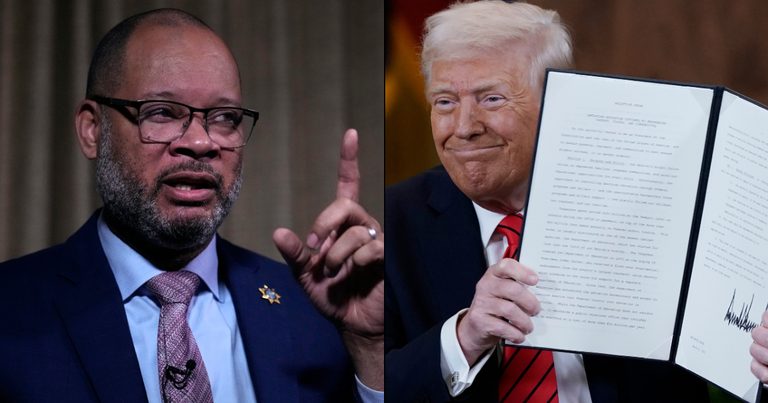
In a decisive victory for Nevada and a coalition of 23 states, U.S. District Judge John J. McConnell, Jr. of Rhode Island ruled that the Trump administration’s attempt to attach immigration‑enforcement conditions to congressionally authorized public safety grants was unlawful. The permanent injunction bars any implementation or enforcement of those conditions, safeguarding more than $1.3 billion in Victims of Crime Act (VOCA) funds.
Local impact and federal overreach
Attorney General and Governor‑elect Aaron D. Ford praised the decision, saying, “Public safety funding is meant to protect communities, not to be used as a political bargaining chip.” He added that the ruling “upholds the rule of law and protects resources that help keep Nevadans safe.” The judgment removes the Trump administration’s threat to withhold critical law‑enforcement and juvenile‑justice funding unless states complied with its immigration‑enforcement demands.
The administration had previously announced that states would lose access to VOCA funds unless they agreed to cooperate with federal immigration enforcement. By tying the Byrne Justice Assistance Formula Grants – a long‑standing source of criminal‑justice funding for state and local governments – to immigration policy, the administration blurred the line between federal immigration responsibilities and state public‑safety needs.
Broad coalition and constitutional arguments
The lawsuit was joined by attorneys general from California, Delaware, New Jersey, Illinois, Rhode Island, Colorado, Connecticut, Hawaii, Maine, Maryland, Massachusetts, Michigan, Minnesota, New Mexico, New York, Oregon, Vermont, Virginia, Washington, Wisconsin, the District of Columbia, and the Commonwealth of Pennsylvania. Their joint brief argued that the conditions violated the Spending Clause of the U.S. Constitution and infringed on the principle of federalism by coercing states into enforcing federal immigration policy.
Judge McConnell agreed, stating that civil immigration enforcement is a federal responsibility and that the administration’s actions “conflict with core principles of American governance, the separation of powers, and federalism.” The ruling therefore protects state autonomy and ensures that public‑safety dollars remain focused on their intended purpose.
What comes next?
While the Trump administration has not yet issued a formal response, the Department of Justice continues to apply similar conditions to new grant programs, including those for law enforcement and juvenile‑justice initiatives. The court’s permanent injunction, however, provides a clear legal barrier that states can rely on when defending their grant funding.
For Nevada, the decision means that local police departments, sheriff’s offices, and community‑safety programs can continue to receive federal assistance without the pressure to adopt immigration‑enforcement policies that fall outside state jurisdiction. Families and neighborhoods across the state will benefit from uninterrupted funding for crime‑prevention, victim‑services, and youth‑justice programs.
Community perspective
Local leaders and community groups have welcomed the ruling, emphasizing that safety resources should never be weaponized for partisan aims. “Our neighborhoods deserve protection, not political games,” said a Nevada law‑enforcement association spokesperson. The decision aligns with the values of traditional families and faith‑based communities that prioritize safe, stable environments for children and seniors alike.
As the Trump administration looks for other avenues to advance its immigration agenda, Nevada and its partner states stand ready to defend the constitutional separation of powers that keeps federal resources focused on public safety, not political coercion.
Original reporting: KTNV 13 Action News Las Vegas (local) — read the source article.