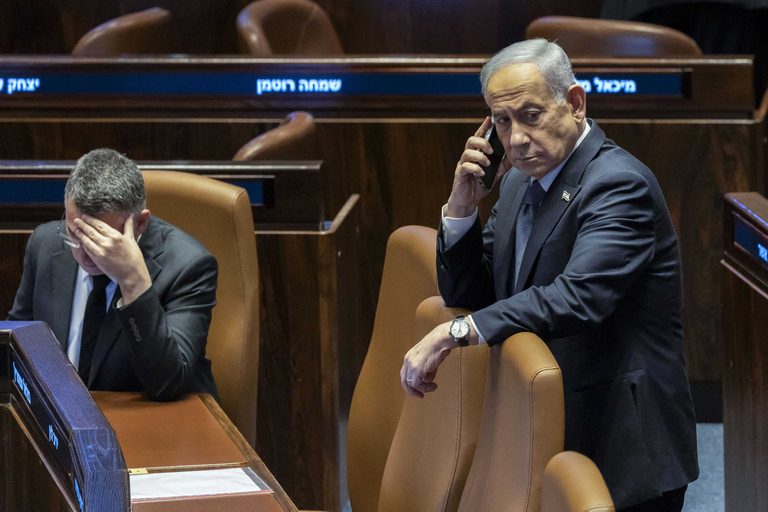
Israel’s prime minister, Benjamin Netanyahu, said on Saturday that a unity government is essential and offered a rotating premiership with his main rival, Gadi Eisenkot. Netanyahu, whose Likud party emerged as the largest faction in the Knesset after the Oct. 27 elections, said he would step aside and let Eisenkot serve as the first prime minister, while he would take the role of alternate premier.
Details of the proposal
In a statement posted to X, Netanyahu emphasized that “unity is the need of the hour.” He argued that Likud’s size justifies his leadership of a unity government or his position at the start of the rotation, but he is willing to set that aside for the sake of forming a stable coalition.
Netanyahu did not specify the length of Eisenkot’s initial term. He called for “genuine, sincere, and accelerated negotiations” between Likud and Eisenkot’s Yashar party, urging both sides to make comparable compromises.
Eisenkot’s response
Eisenkot welcomed the invitation to negotiate, stating that “unity is about substance and values, not about who gets which job or who goes first.” He criticized Likud for not presenting a concrete proposal over the past two weeks and questioned the party’s willingness to engage in serious talks.
According to Eisenkot, a detailed proposal with significant compromise positions was sent to Netanyahu a week earlier via a confidential channel, but he has not yet received a response. Eisenkot has already secured coalition agreements with the right‑wing Yisrael Beiteinu party and the left‑wing Democrats, and is in talks with United Torah Judaism, an ultra‑Orthodox party that previously supported Netanyahu.
Political reactions
Several of Eisenkot’s allies dismissed Netanyahu’s offer as a tactical maneuver. Yair Golan, head of the Democrats, called the move a “bluff” and urged respect for the voters’ desire for change. Former prime minister Yair Lapid labeled the proposal a “transparent con” by a “serial fraudster.”
In contrast, former prime minister Naftali Bennett praised the statement, describing it as the “right decision” and warning against any attempts to form a government without Netanyahu’s involvement. Bennett’s shift follows his earlier criticism of Netanyahu, whom he accused of leading Israel toward civil conflict.
Timeline and stakes
Eisenkot has until Dec. 20 to form a government, with a possible two‑week extension. He has indicated he could bring a new cabinet to a parliamentary vote as early as next week. The proposal also touches on security policy: Arab leader Mansour Abbas of the Raam party reaffirmed that Hamas is a terrorist organization, aligning with Eisenkot’s condition that any coalition must commit to dismantling Hamas.
Netanyahu’s last power‑sharing attempt in 2020 with Benny Gantz collapsed after he refused to pass a state budget, triggering new elections. Observers note that the current proposal seeks to avoid a repeat of that failure by offering a clear rotation plan.
Outlook
The coming days will reveal whether the two leaders can bridge their differences and assemble a coalition that commands a Knesset majority. If successful, Israel could see a government that balances right‑wing and centrist forces while addressing pressing security and economic challenges.
Original reporting: Oklahoma City News Feed (HLL/CB) — read the source article.