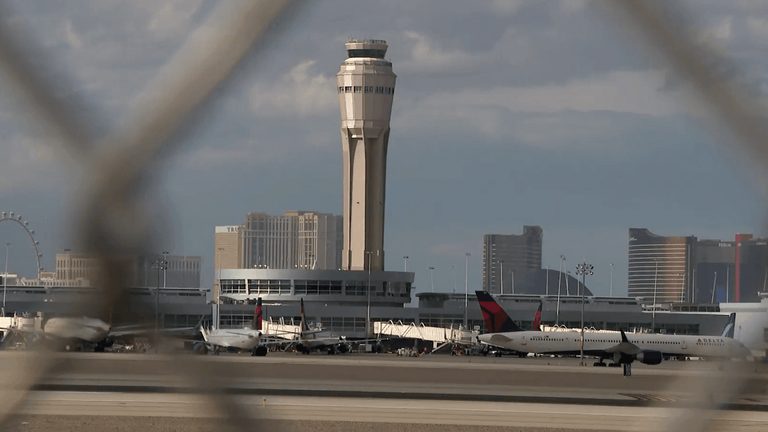
Two major technology failures this week sent ripples across the United States, underscoring the importance of robust backup plans for businesses and critical public services. On Thursday, Microsoft experienced a widespread outage that halted email and other online tools for thousands of users. The following day, the Federal Aviation Administration (FAA) issued a nationwide ground stop after a temporary communications failure disrupted air‑traffic controllers.
Microsoft outage shows vulnerability of third‑party reliance
Cybersecurity specialist Dr. Mack Jackson Jr. explained that the Microsoft incident was not the result of a cyberattack, but rather an infrastructure failure that demonstrates how dependent modern enterprises have become on external vendors. “This gives a great example of what could happen when there is an issue that doesn’t necessarily have to be a cyber attack. It can actually be a failure in the actual infrastructure,” Jackson said.
Jackson warned that when a third‑party provider promises data protection, the fate of the client’s business can become tied to the provider’s stability. “If a third‑party vendor says we have your data and we have it protected, if that third party goes out of business, so does your business,” he noted.
His recommendation is straightforward: companies should develop multiple contingency plans—what he calls a “Plan B” and even a “Plan C”—to ensure continuity if a technology service suddenly disappears.
FAA ground stop reveals aging air‑traffic infrastructure
Dan Bubb, a professor at the University of Nevada, Las Vegas, former airline pilot, and aviation historian, described the FAA’s five‑hour nationwide ground stop as a wake‑up call for modernizing the nation’s air‑traffic control system. “We still use a lot of antiquated equipment in our air traffic control system,” Bubb said.
The outage, which forced airlines to rebook passengers and reposition crews, is only the third nationwide ground stop in recent memory—the previous two occurring after the September 11 attacks and a brief disruption in 2023. Bubb emphasized that upgrading the system should be a priority to prevent future interruptions.
Although the FAA lifted the ground stop quickly, Bubb cautioned that full recovery for airlines could take several days as they work to restore normal schedules.
What the disruptions mean for businesses and travelers
Both incidents illustrate a common theme: critical services are increasingly built on complex, interdependent technology platforms. When those platforms falter, the impact can be felt far beyond the immediate users, affecting supply chains, travel plans, and everyday communications.
Experts suggest that the solution lies in two complementary approaches. First, businesses should diversify their technology providers and maintain offline backups for essential data. Second, federal agencies like the FAA must invest in modernizing legacy systems to reduce the risk of future outages.
In a climate where technology fuels economic growth and daily life, these recent events serve as a reminder that resilience and forward‑looking investment are essential to keeping the nation’s infrastructure running smoothly.
Original reporting: News 3 KSNV Las Vegas (local) — read the source article.