The Myrtle Beach City Council and Horry County officials have cleared the way for four major hotel projects that together will add roughly 800 rooms to the Grand Strand. While each project promises jobs and tourism dollars, three of the four depend on public land or public‑funded incentives.
Margaritaville Resort – Land Swap and Public Amenities
Innisfree Hotels plans a 296‑room, 18‑story Margaritaville resort on the former Chesterfield Inn site near Ocean Boulevard and 17th Avenue North. The developer has pledged $90 million for construction, expects about 350 construction jobs and 200 permanent positions, and projects roughly $8 million in first‑year payroll. The council’s November 10 vote approved an ordinance to exchange city‑owned alleyways for the developer and sell additional parcels at fair market value. In return, the city has asked for boardwalk improvements, a public parking lot and restrooms, though these remain requests rather than binding commitments. The appraised value of the alleys has not been disclosed.
Wavegarden Surf‑Park Hotel – $20 Million Tax Credit
A consortium led by WGMB (Highgate, South Street Partners, Twin Point Capital) will build a 5.5‑acre Wavegarden lagoon and a 150‑unit hotel on the former Palace Theatre parcel at US‑17 Bypass and 21st Avenue North. The city has agreed to provide up to $20 million in a long‑term property‑tax credit, structured as a special source revenue credit. Council members Jackie Hatley and Phil Render voted against the incentive, but it passed 5‑2. The developer must invest at least $150 million and complete 80 percent of the project before any public funds are released, a safeguard that limits taxpayer exposure. Construction is slated for July 2027 with an opening targeted for March 2030, pending final county approval of the business‑park agreement.
Breakers Resort Tower – $2 Million Reimbursement
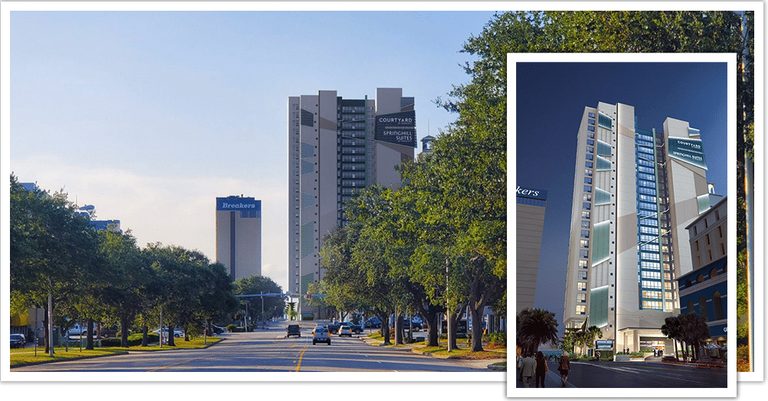
At the ocean end of 21st Avenue North, PBB Development LLC proposes replacing a 107‑unit building with a 230‑unit, 20‑story tower. The council approved a reimbursement of 2 percent of the developer’s $65 million investment, capped at $2 million, with the owner contributing $1.3‑$2 million toward public improvements within the project. Notably, the Planning Commission unanimously recommended denial, but the council set aside that recommendation. The ordinance requires construction to be completed by November 2032, and because the new tower replaces existing rooms, the net addition to the market is about 123 units.
Hampton Inn & Suites in Surfside Beach – Private Investment
OM Hotel Group broke ground on a 127‑room Hampton Inn & Suites at 1100 US‑17 Business in Surfside Beach. The hotel includes a free hot breakfast, indoor pool, fitness center, meeting space and outdoor patio, with an expected opening in spring 2028. Mayor Robert Krouse highlighted the project as one of the town’s largest financial commitments, estimating a cost of $18 million, while OM partner Vic Shah cited a $25 million investment. No public land swap, tax credit or reimbursement is attached; the town will benefit from additional taxable capacity under its existing hospitality and accommodations taxes.
What Residents Should Watch
These projects illustrate a growing pattern: public assistance—whether land, tax credits or reimbursements—is becoming the norm for large‑scale hotel development in Myrtle Beach. While the surf‑park credit includes a performance trigger that protects taxpayers, the Margaritaville land swap and Breakers reimbursement lack comparable safeguards. Residents are encouraged to attend upcoming public hearings, review council minutes, and ask council members why differing terms were applied to similar projects. Transparency on the value of exchanged alleyways and the timeline for public‑funded contributions will be key to ensuring that the community’s interests are protected as the Grand Strand’s skyline continues to rise.
Original reporting: MyrtleBeachSC News — read the source article.