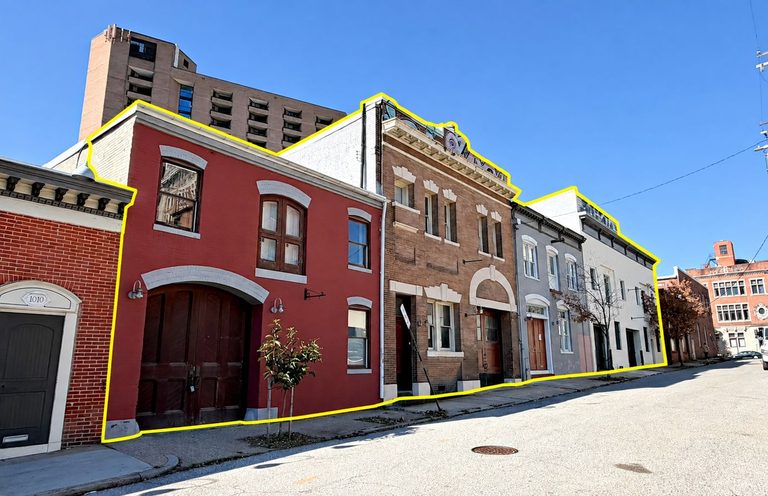
A row of four historic carriage houses on Morton Street in Baltimore’s Mount Vernon Historic District has been sold at auction for a total of $1.575 million. The sale, conducted by Alex Cooper Auctioneers, includes the buildings at 1012, 1014, 1016 and 1018‑1020 Morton Street.
Details of the transaction
The auction began on Nov. 7 with an opening bid of $1 million. The winning bid reached $1.5 million, and after a five‑percent buyer’s premium the final price came to $1.575 million – roughly $400,000 per building. The properties together contain about 28,000 square feet of contiguous retail and office space and provide 34 parking spaces.
Auctioneer Paul Cooper confirmed that the buyer is a local investor, though he declined to disclose the identity pending settlement of the sale.
Historic preservation considerations
Because the carriage houses sit within a designated historic district, any exterior alterations must be reviewed and approved by the city’s Commission for Historical and Architectural Preservation (CHAP). Four years ago, CHAP approved a proposal by the former owner, Howard Chambers, to construct approximately 64 apartments on the rear portion of the property, but the project never moved forward.
The recent sale suggests that CHAP may be open to similar adaptive‑reuse proposals in the future. However, any new exterior changes proposed by the current buyer will need to be submitted as a fresh application to the preservation panel.
Broader market activity
The Morton Street transaction is one of two multi‑building sales handled by Alex Cooper Auctioneers this month, indicating continued investor interest in the Mount Vernon‑Midtown area. The other sale involved the “Apartments on Biddle,” a nearly block‑long row of townhouses at 38‑50 West Biddle Street. That assemblage, which includes 35 fully‑leased apartments, one commercial space (Pillion Tea), and 12 off‑street parking spaces, fetched a top bid of $3.25 million plus a buyer’s premium, bringing the total to $3.445 million.
Both sales underscore the vitality of Baltimore’s historic‑district real‑estate market, where investors are attracted to the blend of historic character and flexible commercial or residential use.
What this means for the community
Local investors retaining ownership of historic properties can help preserve the architectural heritage of Mount Vernon while providing space for businesses and offices that serve neighborhood residents. The potential for adaptive‑reuse projects also aligns with the city’s broader goals of revitalizing historic districts without sacrificing their unique character.
Stakeholders, including preservation advocates and neighborhood groups, will be watching the next steps closely to ensure that any redevelopment respects the district’s historic fabric and meets the needs of the community.
Original reporting: Baltimore Fishbowl — read the source article.