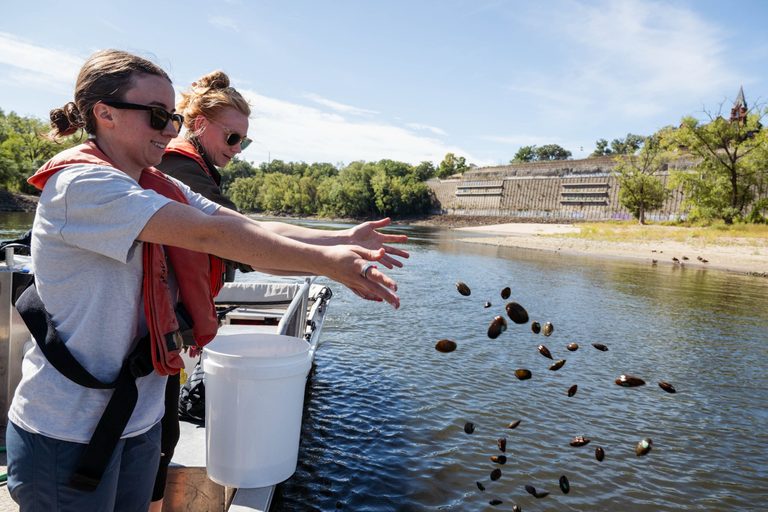
After a quarter‑century of reintroduction work, the Minnesota Department of Natural Resources (DNR) reports that native freshwater mussels are finally taking hold in the Upper Mississippi River near the Twin Cities. On a September afternoon, DNR biologists scattered roughly 400 mucket and Higgins eye mussels—each just over an inch wide—into a half‑mile stretch of river between St. Paul and Minneapolis.
Long‑term effort pays off
Since 2001 the DNR has been seeding the river with about 45,000 mussels of four threatened or endangered species, including mucket, Higgins eye, snuffbox and winged mapleleaf. The effort involves raising the mussels in a laboratory in Lake City for about five years before releasing them into the wild.
“You spend five years raising these little guys just to throw them out,” said propagation biologist Lindsay Ohlman. “It’s a little anticlimactic,” she added, noting the bittersweet nature of the final release.
Why mussels matter
Freshwater mussels act as ecosystem engineers. Their dense beds help prevent riverbank erosion, provide habitat for other aquatic species, and filter water by removing bacteria, algae and metals. Historically, the Mississippi’s bottom was so full of mussels that it resembled a cobblestone street, but overharvesting, dam construction and invasive zebra mussels decimated populations.
Today, the DNR estimates that 40% to 80% of reintroduced mussels survive each year at other sites, and early monitoring suggests similar survival rates in the Mississippi stretch. Researchers have even found untagged, smaller mussels, indicating that the introduced adults are reproducing.
Broader restoration context
The Twin Cities project is part of a larger state initiative to restore mussels in the Cedar and Cannon River watersheds and across the Upper Mississippi. The DNR’s work complements federal endangered‑species protections and recent improvements in water quality from wastewater‑treatment upgrades and stricter Clean Water Act enforcement.
While the current release marks the last scheduled planting for now, biologists will continue to monitor growth and reproduction, letting nature take its course as the mussels establish a foothold.
Original reporting: Wisconsin Watch — read the source article.