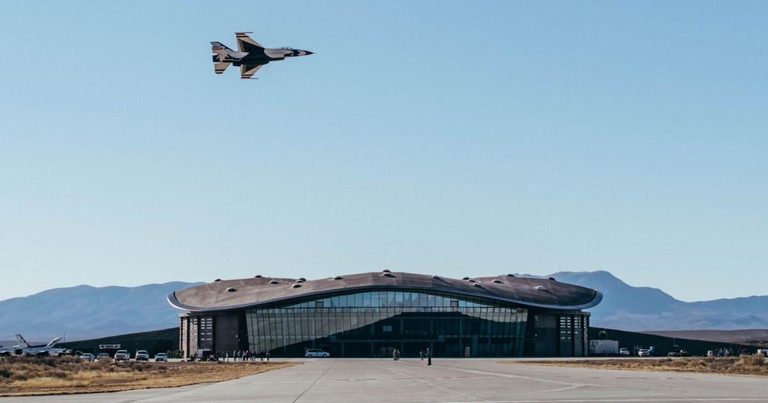
Spaceport America in New Mexico and Midland International Air and Space Port in Texas have signed a letter of intent to establish a high‑speed flight test corridor spanning roughly 250 nautical miles (about 288 standard miles) of sparsely populated airspace across West Texas and Southern New Mexico, according to the Santa Fe New Mexican. The agreement aims to support “high‑cadence” supersonic and hypersonic flight testing, including sonic‑boom measurement and air‑traffic‑integration development.
Justine Ruff, director of Midland International, said the partnership offers an opportunity to shape the future of aerospace while demonstrating how traditional aviation and emerging space technologies can safely coexist. “By connecting two licensed spaceports through a high‑speed flight corridor, we have an opportunity to help shape the future of aerospace while demonstrating how traditional aviation and emerging space technologies can safely and successfully coexist,” Ruff stated.
Scott McLaughlin, executive director of Spaceport America, called the prospect “very exciting” and noted that the corridor would uniquely enable subsonic, supersonic, and high‑altitude experiments. “We look forward to working to implement this to serve both national security and civil needs, and to build the aerospace ecosystem in both locations,” McLaughlin added.
Charlie Hurley, spokesperson for the New Mexico Spaceport Authority, clarified that no specific timeline has been set; the letter of intent simply marks the project’s first step. Both spaceports already hold Federal Aviation Administration (FAA) licenses for launch‑site operations, but any aircraft using the corridor would still need FAA certification, Hurley wrote.
The proposed corridor will cross airspace managed by the FAA as well as the U.S. Army’s White Sands Missile Range, which surrounds Spaceport America’s 18,000‑acre site. Coordination with White Sands will be required because aircraft traveling the corridor would pass through both missile‑range and FAA‑controlled airspace.
For Midland residents, the corridor could bring new aerospace jobs, increased federal investment, and opportunities for local businesses to support testing operations. The region’s open skies and existing infrastructure position it well to become a hub for next‑generation flight testing, aligning with national security and commercial interests.
What’s next? The two spaceports will begin detailed planning and environmental reviews, seek FAA certification for corridor users, and coordinate with White Sands Missile Range on airspace usage. Stakeholders anticipate public briefings and possible community meetings later this year to discuss the project’s impact and timeline.
Sources: santafenewmexican.com