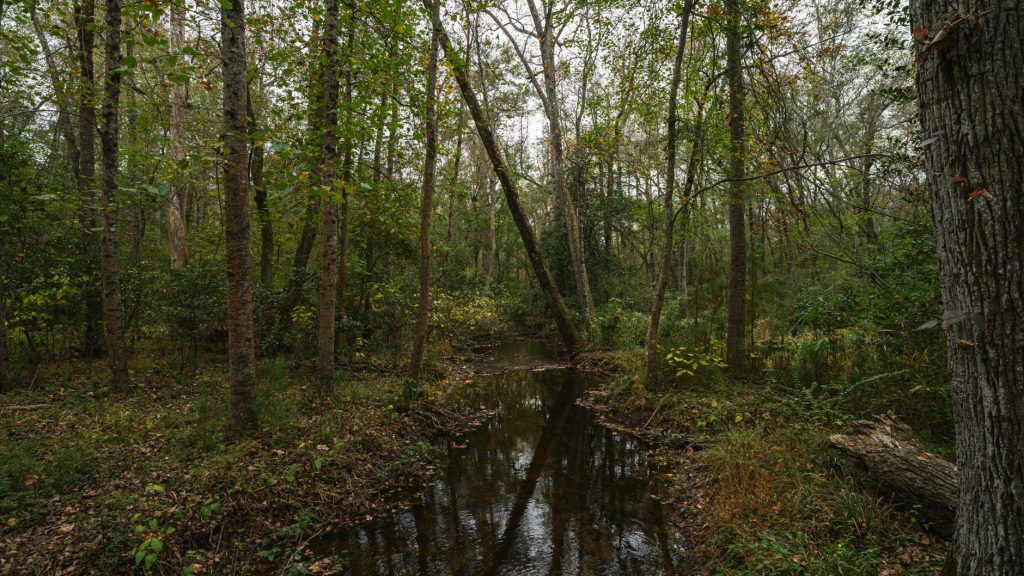
On a Tuesday morning in late October, a great blue heron stood at the edge of Pattersquash Creek and didn’t move for eleven minutes. That’s the pace out here. If you arrive expecting something manicured — a paved loop with signage every quarter mile — you’re going to need to recalibrate quickly.
The Pattersquash Creek Trail runs through the Mastic unit of Wertheim National Wildlife Refuge, which sits along the southern edge of Mastic Beach near the Forge River watershed. It’s not the same as the main Wertheim entrance off Rte 27 in Calverton — this section is accessed from Mastic Road, and the distinction matters. The parking pull-off is modest, easy to miss, and the trailhead feels provisional in the best way: a wooden post, a map box that may or may not have maps in it, and then a grass path that curves into the reeds.
The trail itself runs roughly two miles out and back, following the eastern edge of Pattersquash Creek as it widens toward Mastic Bay. The terrain shifts more than you’d expect from the topography. There are sections of upland oak scrub where the ground is dry and the light comes in sharp through the canopy; then the path drops toward the marsh edge and the air changes entirely — saltier, heavier, the smell of exposed mudflat at low tide. Bring footwear that can handle wet ground in spots near the creek bend. It’s not a muddy slog, but light sneakers will leave you annoyed.
This is birding territory. Serious birders know this stretch; the osprey population along the creek is dense in spring and summer, and the fall migration pushes warblers, sparrows, and shorebirds through in enough variety to make the walk take twice as long as planned. A pair of glossy ibis turned up here two autumns ago, and the local birding forums made note of it for weeks. You don’t need to be a birder to appreciate what’s moving through, but a pair of binoculars adds considerably to the experience.
There’s no fee. No concession stand, no restrooms, no visitor center at this unit. That’s not a complaint — it’s the point. The main Wertheim facility has those things; Pattersquash has silence and actual wildlife. Cell service is inconsistent once you’re past the first quarter mile, which feels like a fair trade.
The best times to go are early morning on weekdays or at either end of the main seasons — April through May, September through November. Summer weekends can draw more foot traffic because Mastic Beach residents know this spot, but it never gets crowded by any reasonable standard. Midday in July is probably the least rewarding version of this walk: insects are aggressive, the marsh smell intensifies, and birds tend to go quiet in the heat.
What this trail does well is resist being turned into an experience. There’s no narrative arc, no payoff overlook at the end with a plaque explaining what you’re looking at. The creek widens, the path turns back, you retrace. What you carry away depends entirely on how slowly you moved and how much you paid attention. Most people, after an hour here, look a little surprised at themselves — not because anything dramatic happened, but because they didn’t check their phone once and can’t quite account for where the time went.
That’s about all it promises, and it delivers on that every time.