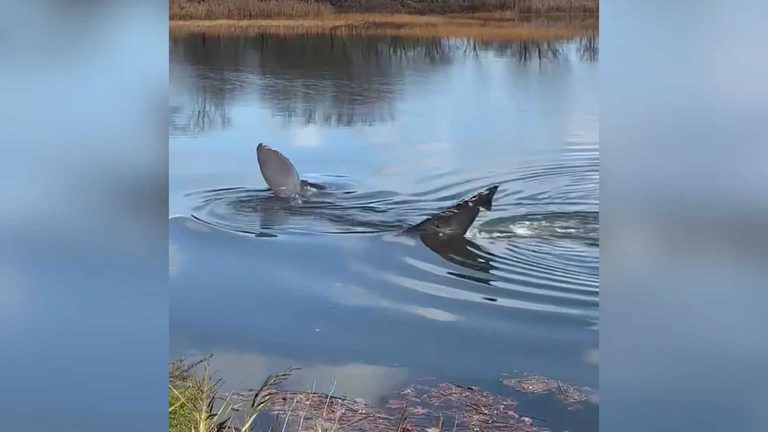
Quincy, Mass. – Residents of Quincy were treated to an unexpected marine visitor on Friday when a massive basking shark glided through the waters of the city’s harbor. The gentle giant, estimated at 20 to 28 feet long and weighing several tons, was seen near the marshy stretch off the road known locally as Southern Artery.
Local reaction
Eyewitnesses described a mixture of awe and curiosity as the shark moved slowly along the coastline. “It was incredible to see something that size so close to home,” said one Quincy resident who filmed the encounter on a smartphone. Social media posts quickly spread, with neighbors gathering at the waterfront to watch the unusual sight.
Scientific perspective
John Chisholm, an adjunct scientist with the New England Aquarium, explained that basking sharks are the second‑largest fish in the world and typically feed on zooplankton near the surface. “These sharks migrate south for the winter,” Chisholm said. “While they are common in Massachusetts waters, they rarely enter Quincy Harbor. They usually appear in harbors and estuaries as they navigate along the coast.”
Chisholm also noted a recent sighting in Salem Harbor a week earlier, suggesting that the sharks may be following a broader seasonal pattern along the New England shoreline.
What to know about basking sharks
Basking sharks grow to lengths of 20‑28 feet and can weigh several tons, making them one of the ocean’s most impressive inhabitants. Despite their size, they are harmless to humans, feeding primarily on microscopic plankton. Their slow, graceful movements often give the impression that they are “basking” in the sun, which is how they earned their common name.
Because they are filter feeders, basking sharks pose no threat to swimmers or boaters. However, experts advise maintaining a safe distance and avoiding sudden movements that could startle the animal.
Community response and safety
Local officials reminded residents to respect the marine environment and to keep a safe distance from the shark. The Quincy Police Department issued a brief advisory, encouraging onlookers to observe from the shoreline rather than attempting to approach the animal in the water.
Marine biologists continue to monitor the shark’s movements, hoping to gather more data on its migration routes and habitat use along the Massachusetts coast.
Looking ahead
While sightings of basking sharks in Quincy are rare, the recent appearances in both Quincy and Salem suggest that the species may be more active in the region this winter than previously thought. Residents are encouraged to stay informed through local news outlets and the New England Aquarium for any updates on marine wildlife in the area.
Original reporting: Oklahoma City News Feed (HLL/CB) — read the source article.