The Massachusetts Supreme Judicial Court has scheduled oral arguments for January to hear the appeal of Lindsay Clancy, who is seeking to have murder charges dismissed after a mistrial. The appeal centers on whether a second trial would violate her constitutional protection against double jeopardy.
Background of the mistrial
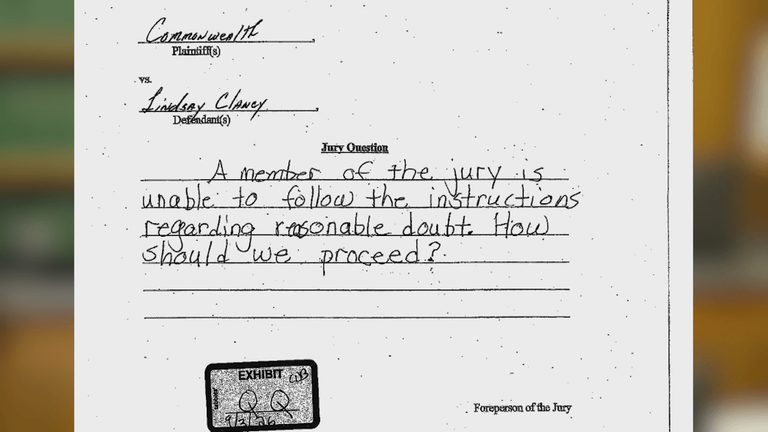
Clancy’s first trial ended in a mistrial when the jury was declared deadlocked. The deadlock stemmed from a single juror who, according to notes from the jury foreperson, could not follow Judge William Sullivan’s instructions on the legal standard of reasonable doubt. After the foreperson’s first note indicated the juror was unable to apply the standard, Judge Sullivan individually questioned each juror at the bench. The holdout juror responded, “Yes, sir,” prompting the judge to re‑instruct the jury on reasonable doubt.
A second note from the foreperson, written a day later, reported that the juror acknowledged doubt but refused to apply it to the verdict. Defense attorney Kevin Reddington asked Judge Sullivan to remove the juror and replace him with an alternate, but the judge denied the request.
Side‑bar dispute
Transcripts obtained by NBC 10 News reveal a heated side‑bar between Reddington and Judge Sullivan. Reddington argued, “It’s just not right. It stinks. It’s not right, judge.” Sullivan replied, “I don’t think it stinks,” and expressed displeasure at what he called personal attacks. When Reddington continued to press the issue, Sullivan brought the discussion into open court, where Reddington accused the juror of lying about following the law.
Ultimately, Judge Sullivan declined to remove the juror, declared the jury deadlocked, and entered a mistrial. Following the mistrial, Clancy’s attorneys moved to dismiss the charges on double‑jeopardy grounds. The judge rejected that motion, leading the defense to appeal.
Significance of the Supreme Judicial Court review
Former prosecutor Margaret McLean highlighted the importance of the case, noting that the Supreme Judicial Court’s decision to hear the matter before all seven justices is “huge.” A ruling in favor of the defense could reshape how much a trial judge may intervene in jury deliberations, potentially limiting judicial authority in future criminal trials.
The appeal raises two core legal questions: (1) whether a judge may remove a juror who appears unwilling or unable to follow legal instructions, and (2) whether a second trial after a mistrial would constitute double jeopardy. Both issues touch on fundamental constitutional protections and the balance of power between the bench and the jury.
What’s next?
Oral arguments are set for January before the Massachusetts Supreme Judicial Court. The outcome will be closely watched by legal scholars, prosecutors, and defense attorneys across the Commonwealth, as it may set precedent for future criminal proceedings involving juror disputes.
For residents of Massachusetts, the case underscores the importance of a fair and transparent judicial process—principles that align with our community’s commitment to the rule of law, family stability, and individual liberty.
Original reporting: NBC 10 WJAR (Sinclair) – local — read the source article.