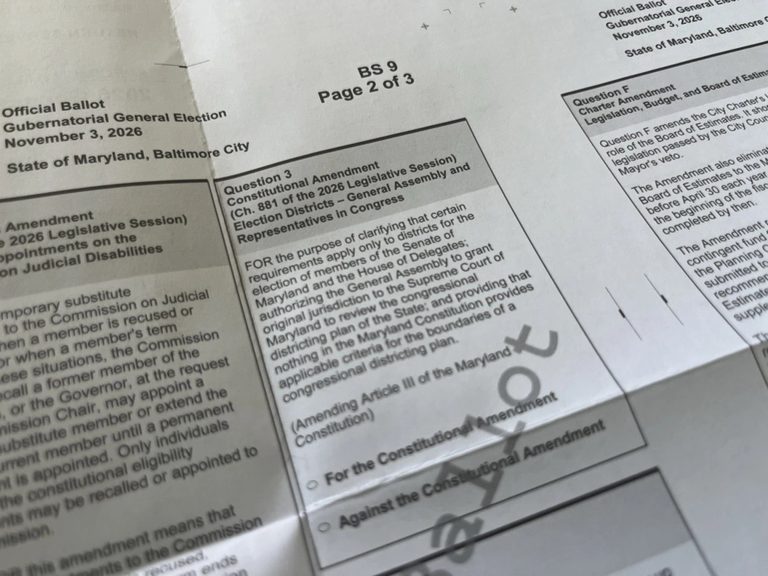
Maryland voters have spoken loudly on the issue of congressional redistricting. On the November ballot, Question 3 received roughly six‑in‑ten “yes” votes, signaling strong public support for loosening the state’s strict redistricting guidelines.
What the measure changes
Under the current Maryland Constitution, congressional districts must be drawn so that they are contiguous, respect natural boundaries such as rivers and mountains, and honor existing political subdivisions like counties and municipalities. Question 3 eliminates those three mandates, giving the legislature greater flexibility when crafting the next congressional map.
Why the change matters
Proponents argue that the amendment will allow for more practical district designs that reflect population shifts and community interests without being shackled by rigid geographic constraints. More importantly, the new flexibility could help protect Maryland’s sole Republican‑represented district, the 1st Congressional District, currently held by Rep. Andy Harris (R‑District 1). By allowing districts to be drawn without the contiguity requirement, a map that groups additional Democratic voters around Harris’s district could be crafted to withstand legal challenges, preserving the bipartisan representation that many Maryland families value.
Legislative response
State lawmakers have welcomed the voter mandate but caution that further discussion is needed before deciding whether to redraw the map ahead of the 2028 election cycle. “The people have given us clear direction to modernize our redistricting process,” said a senior Democratic legislator. “We will now engage with stakeholders across the state to ensure any new map reflects both the will of the electorate and the principles of fair representation.”
Republican leaders, while acknowledging the vote, emphasize the need for transparency and local input. “We appreciate the voters’ desire for flexibility, but we must guard against partisan gerrymandering that could dilute the voice of our communities,” a Republican delegate noted.
Potential impact on future elections
If the legislature moves forward with a new map before 2028, the altered boundaries could influence the balance of power in Maryland’s congressional delegation. The state currently sends eight members to the U.S. House, with seven Democrats and one Republican. Maintaining a competitive 1st District aligns with the broader principle of ensuring that both major parties have a realistic chance to serve Maryland families.
Legal experts point out that any new map will still be subject to federal and state judicial review. However, the removal of the contiguity and natural‑boundary requirements may make it easier for the map to survive challenges, as courts have historically scrutinized districts that appear to be drawn solely for partisan advantage.
Next steps for Maryland residents
The General Assembly is expected to hold hearings and public forums over the coming months to gather input from citizens, community groups, and local officials. Residents are encouraged to stay informed and participate in these discussions, ensuring that the final map reflects the values and needs of Maryland families.
As the state moves forward, the bipartisan spirit that guided the ballot measure—respect for local input, a desire for practical governance, and a commitment to fair representation—should remain at the forefront of the redistricting conversation.
Original reporting: Baltimore Fishbowl — read the source article.