Lubbock County is currently relying on its backup ballot scanner to process the November 3 election results after the primary central scanner experienced technical problems. The county’s elections staff confirmed the backup unit is handling the workload while officials consider a long‑term solution.
Judge Curtis Parrish’s timeline
County Judge Curtis Parrish told commissioners that he prefers to postpone any major purchase until after the 2028 presidential general election. “My suggestion … is to put off any purchase like this until after the 2028 presidential general election,” Parrish said at the special meeting on November 16.
Parrish explained that a 2029 overhaul would allow the county to replace the entire voting‑system infrastructure in one go, rather than in phased upgrades that could disrupt future elections. He emphasized that waiting would give the county time to secure financing and evaluate the best technology options.
Elections administrators weigh costs and options
Former elections administrator Roxzine Stinson warned that the central scanner will need replacement before a full system overhaul can occur. Troy Havard, the current elections administrator, said the primary scanner’s maintenance contract with vendor Cranel will not be renewed after summer 2027, leaving the county without vendor support for the existing equipment.
Havard recalled an earlier estimate of roughly $25,000 for a single central scanner but noted that no current stand‑alone quote has been presented. He added that the least‑expensive Hart InterCivic option would replace only polling‑place scanners, not the central unit.
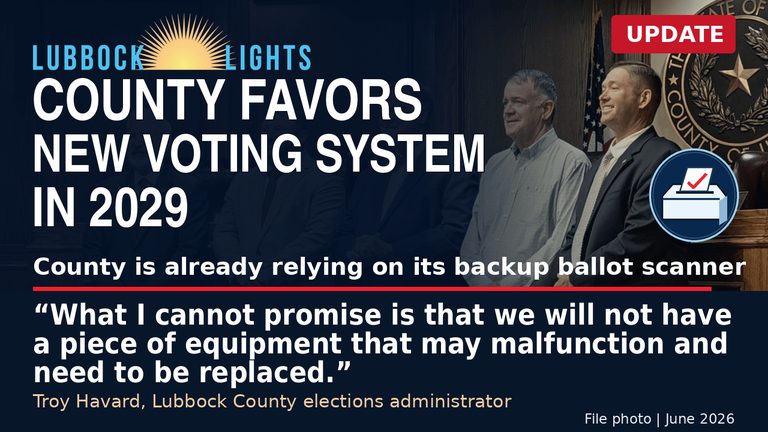
“I have every confidence that it will serve us well,” Havard said of the existing system. “What I cannot promise is that we will not have a piece of equipment that may malfunction and need to be replaced.”
Cost proposals under review
Lubbock Lights obtained three vendor quotes for a system upgrade. The proposals ranged from $1,508,693.75 for a polling‑place scanner upgrade to $8,985,550 for a full replacement, plus $521,115 in annual costs beginning in the second year. A third option was quoted at $7,171,500.
Commissioners asked whether Hart would offer a discount for taking back the old equipment, but no discount amount was established during the meeting. Financing options are available, though Havard said no grant funding has been identified yet.
Next steps
The commissioners did not approve a purchase or set a timetable at the November 16 meeting. They did, however, approve the canvass of the November 3 election results. The county will continue to use the backup scanner while the board deliberates on the best path forward, balancing fiscal responsibility with the need for reliable voting equipment.
Stakeholders, including local election officials and the county judge, agree that any major investment should be timed to avoid interfering with the 2028 presidential election cycle. The discussion underscores the importance of maintaining election integrity while managing taxpayer resources responsibly.
Original reporting: Lubbock Lights — read the source article.