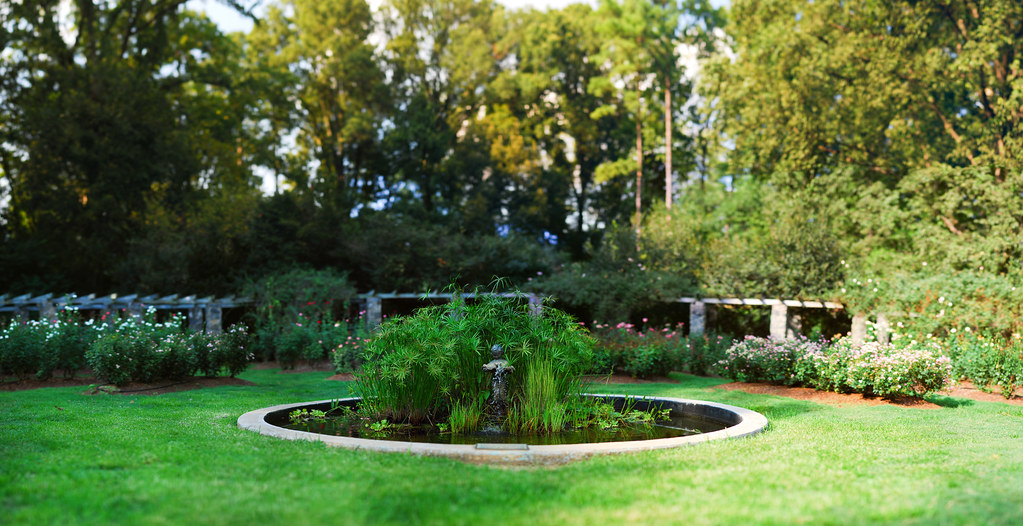
The gate at Raleigh Rose Garden is one of those wrought-iron affairs that swings open without fanfare, and on a Thursday morning in late May, I walked through it into something that stopped me mid-stride. Something like four hundred rose bushes in full bloom, laid out in neat beds along brick pathways, with the kind of color saturation that feels almost unreasonable in a city park. No admission charge. No crowds. Just a retired couple walking a beagle and a woman sketching in a spiral notebook on a wooden bench.
The garden sits on Pogue Street in the Roanoke Park neighborhood, adjacent to Raleigh Little Theater and tucked behind a tidy hedge row that makes it easy to miss if you’re driving. On foot it’s much more findable — about a ten-minute walk from the Village District, or a quick bike ride from Cameron Village. I’d passed it a dozen times before I ever turned in.
It was originally planted in the 1950s by the city, and it shows that kind of considered age. The beds are organized by variety — hybrid teas, grandifloras, climbing roses trained up wooden trellises along the perimeter — and each section is labeled with small metal stakes so you can actually learn what you’re looking at. I spent twenty minutes just in the David Austin section, where the blooms are the old-fashioned cupped kind that smell the way people wish all roses smelled. If you’ve spent any time in English garden tourism, these are going to feel familiar.
The peak window runs roughly mid-May through mid-June for the first flush, then again in early October for the fall rebloom. Both are worth a separate trip. In June the fragrance is remarkable — you catch it before you see the garden, walking up the sidewalk. By summer’s middle stretch the blooms thin out and it becomes more of a green space than a showpiece, so plan accordingly if color is your reason for going.
There’s no café, no gift shop, no programming to sign up for. It’s a city park in the straightforward sense: maintained, open daily from dawn to dusk, free to enter, no reservation required. The pathways are paved and mostly level, which makes it accessible for strollers and wheelchairs without being sterile. Seating is limited to a handful of benches, so if you’re planning a long sit, bring something to put on the ground.
What I keep returning to is the scale. It’s not a botanical garden with interpretive signage and sponsored wings. It’s about three acres, intimate enough that you can walk the whole thing in fifteen minutes and still feel like you’ve absorbed it. That intimacy is the point. Morning light hits the eastern beds around eight, which is when I’d recommend going — the shadows are long, the temperature is manageable, and you’ll probably have large stretches of it to yourself.
I’ve brought visiting friends here three times now, and every time the reaction is the same: mild surprise, then quiet pleasure, then someone pulling out a phone to take pictures they’ll actually use. It photographs easily, which is either a shallow reason to go or a useful one depending on your relationship to that kind of thing. Either way, it’s real — the light, the color, the smell. No filter required.