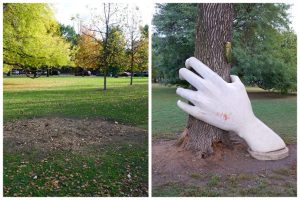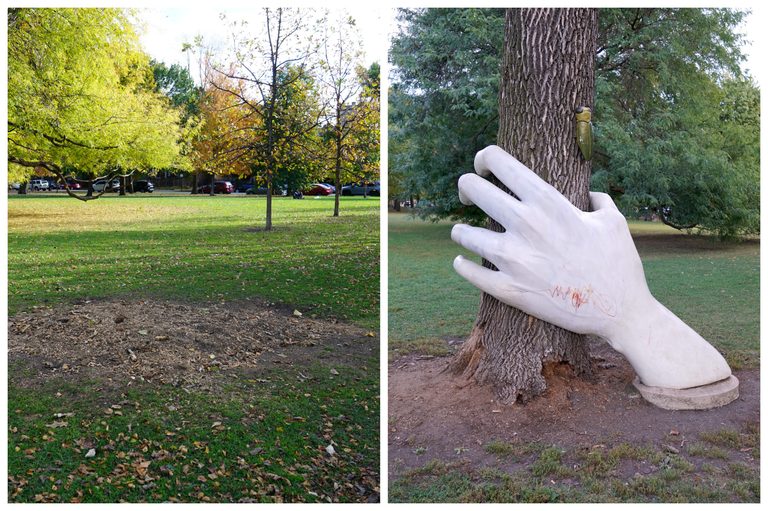
Logan Square’s Palmer Square Park has lost one of its most recognizable landmarks. The large white hand sculpture, known locally as the “Helping Hand,” was taken down last weekend by its creator, artist Carrie Fischer, after the tree that supported it was deemed unsafe.
Fischer told neighbors she was surprised by how deeply the piece had been embraced. “I didn’t realize it was so loved in the neighborhood and its association with this beautiful park in the city,” she said, adding that she was touched by the community’s reaction.
Why the sculpture was removed
The hand was one of two art installations that grew from the Chicago Tree Project, a partnership between the Chicago Park District and Chicago Sculpture International that began in 2014. The program turns dead or dying ash trees—often killed by the emerald ash borer—into three‑dimensional works of art. When the supporting trees at Palmer Square Park decayed, the park district removed both the hand and the “A”Maze”ing Larvae of the Emerald Ash Borer” by artist Janet Austin.
Park District spokesperson Irene Tostado explained that the district is slated to remove 16 of the remaining 21 art trees by year‑end after inspections revealed structural decay caused by weather and natural forces. “The Park District once boasted 54 of these creative tree projects district‑wide, and they represented an artistic response and commitment by the Park to breathe ‘new life’ into dead and dying ash trees,” Tostado said.
Community response and fundraising effort
Although the removals are part of a planned, temporary lifecycle—artists were told the works would last two to five years—neighbors say the hand has become an iconic symbol of the area. Jay Mathur, a member of the Palmer Square Advisory Council, launched a campaign Thursday to raise $30,000 by the end of the year to purchase the sculpture from Fischer and donate it to the park district.
Mathur, who has lived nearby for five years, said the hand has been the logo for his weekly Palmer Bar Runs, a running club he started three years ago. “It’s eye‑catching, creative, it stands out; I like when a piece of art makes you just stop,” he said. “If we get over $30,000, it could be something bigger and better.” The funds would cover the artwork’s transport, insurance and any necessary repairs.
Next steps
Fischer has placed the sculpture in her studio for winter repairs. Once restored, the piece could be shipped to a new location or returned to Logan Square if the fundraising goal is met and the park district approves the donation.
Both Mathur and Fischer noted that neighbors have already asked how they can help. “It has been a surprise and inspiration, how deeply the neighborhood connected to the sculpture,” Fischer said.
The effort highlights how local residents are willing to invest time and money to preserve public art that reflects community identity, even as the city’s broader art‑tree program winds down.
Original reporting: Block Club Chicago — read the source article.