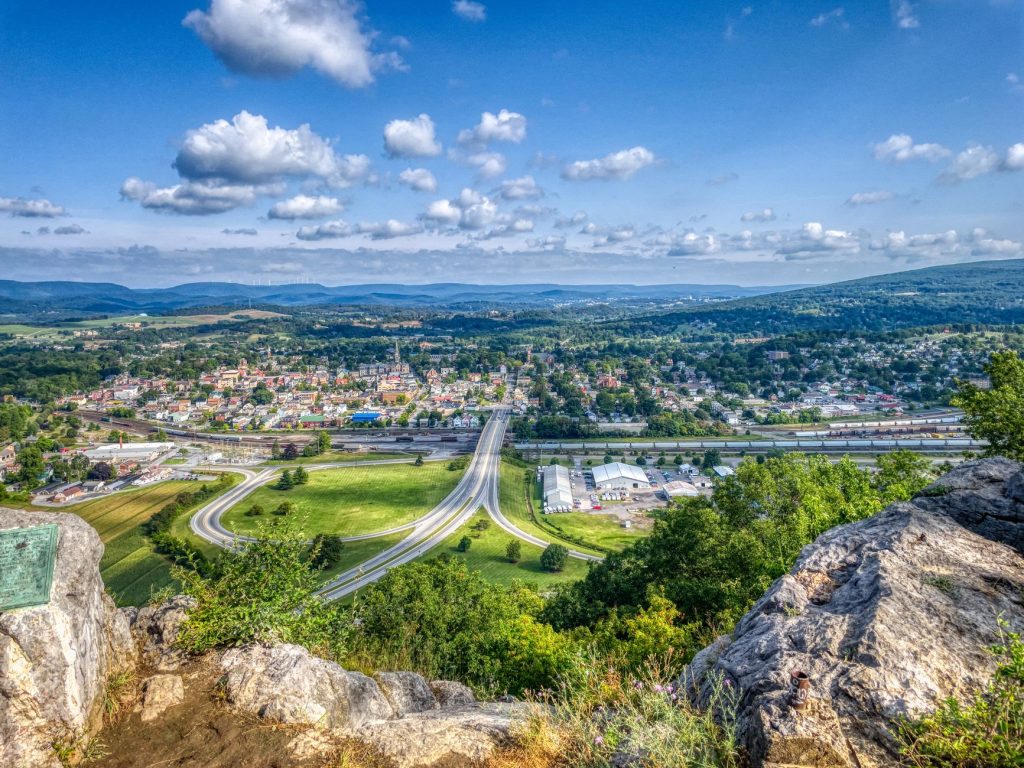
The Laurel Highlands Visitors Bureau has been fielding questions about Frank Lloyd Wright since 1975. That’s not a boast — it’s just what happens when your territory includes two UNESCO-listed structures and a stretch of Pennsylvania that tourists routinely underestimate until they’re standing in the middle of it.
The Bureau’s main office sits on Memorial Boulevard in Uniontown, a short walk from the Fayette County Courthouse square. The building isn’t grand. It looks like a repurposed professional office, which is essentially what it is. But what’s inside — specifically, the staff — is worth the stop, particularly for anyone who showed up in southwestern Pennsylvania without a fully formed plan.
The people who work the front desk here tend to have real opinions. Ask about hiking trails and you’ll get a tiered answer: the Laurel Highlands Hiking Trail for the committed, Dunbar Creek for something shorter, the GAP connector if you’re on a bike. Ask about restaurants and the recommendations are specific enough to be useful — not a laminated list of advertisers, but the kind of off-the-cuff suggestion that includes a caveat like “they close early on Tuesdays, so call first.”
The printed materials are genuinely extensive. Rack after rack of brochures covers everything from regional wineries to covered bridges to battlefields. The battlefield coverage alone spans three or four separate pamphlets. For anyone researching the French and Indian War geography — Fort Necessity, Jumonville Glen, Braddock’s Road — this is a better starting point than most websites, partly because the staff can explain which sites require a reservation and which ones you can simply walk into.
There’s also a small display area with rotating regional history exhibits. Nothing on the scale of a full museum, but enough to orient a first-time visitor to why this particular corner of Appalachian Pennsylvania has produced so much history — and so many recreational draws — relative to its size. The coal and coke heritage, the National Road, the Native American mound sites, the architectural landmarks: all of it gets at least a mention.
Walk-ins are welcome during regular business hours, Monday through Friday, roughly nine to five. No admission charge, obviously. The Bureau also runs a website with a trip-planning tool, but the in-person visit yields something the website doesn’t: someone who will look at your itinerary and tell you, honestly, whether it’s realistic. People sometimes plan to hit Fallingwater, Kentuck Knob, Fort Necessity, and a river float all in one day. The staff will gently explain why that doesn’t work.
Travelers coming specifically for outdoor recreation — the Youghiogheny, the hawk watch, the ridge trails — sometimes skip this kind of stop on principle, assuming they’ve researched enough. That’s usually fine. But for anyone whose plans are still loose, or who suspects there’s something worth seeing that the algorithm hasn’t surfaced yet, spending twenty minutes at the Visitors Bureau tends to surface two or three of those things. The staff has been at this long enough that they remember which overlooks don’t get crowds and which seasonal events fill up fast. That’s institutional knowledge, and it’s free.