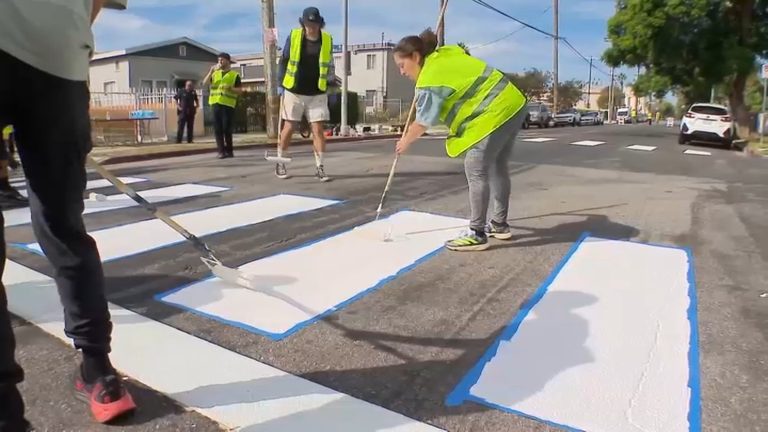
Los Angeles City Councilmember Katy Yaroslavsky moved on Wednesday to explore a volunteer‑based pilot that would allow community members to help repaint existing, city‑approved crosswalks. The motion asks the Los Angeles Department of Transportation (LADOT) to study the feasibility of the program and to develop safeguards that ensure safety and compliance with engineering standards.
Background and community response
For more than a year, a grassroots group called People’s Vision Zero has been painting crosswalks on its own, citing a lack of safe pedestrian crossings near a park at Stoner and Nebraska avenues. Founder Jonathan Hale says the illegal painting was a form of protest for safer streets and more effective government action. After a viral video of his arrest, Hale worked with the mayor’s office and advocated for a legal pathway to continue the work.
“We’d like to see a society that’s more walkable, more accessible to people, where people have more freedom to move,” Hale said. He added that the proposed pilot would let volunteers operate within the law, providing a constructive outlet for community members who want to improve pedestrian safety.
Details of the proposed pilot
The motion distinguishes between installing new crosswalks, which requires professional engineering review, and repainting existing, approved crosswalks. Repainting could offer an additional opportunity for community involvement, provided appropriate safeguards are in place, the motion reads.
Supporters of the measure argue that proven traffic‑calming methods—such as painted crosswalks, speed‑reduction measures, and better lighting—can make streets safer for pedestrians and cyclists. Beverly Shelton, whose grandson was killed in a traffic accident in Northern California, praised the city’s step, saying, “You take your life in your own hands when you go out and walk. It should be a safe thing to do, and it’s not.”
Next steps
The motion now heads to a council vote. If approved, LADOT would conduct a feasibility study, outline training requirements for volunteers, and establish oversight mechanisms to ensure that any repainting meets city standards.
Hale expressed optimism that the pilot could lead to broader changes in how Los Angeles builds and maintains its infrastructure. “I think there’s a lot of things that we can do to make our streets safer,” he said. “A lot of proven methods of slowing down cars, creating a more friendly environment for pedestrians and cyclists.”
Implications for the community
Should the pilot move forward, it could serve as a model for other neighborhoods seeking to address pedestrian safety gaps without waiting for lengthy municipal processes. By involving volunteers, the city hopes to foster a sense of ownership among residents and encourage collaborative solutions to traffic safety challenges.
City officials have indicated that any volunteer activity would be closely monitored to prevent confusion for drivers and to maintain the integrity of traffic markings. The study will also examine liability concerns and the need for proper training and equipment.
Local advocacy groups are watching the proposal closely, ready to provide input on best practices and to help recruit volunteers if the program is authorized. The outcome of the council vote will determine whether Los Angeles takes a pioneering step toward community‑driven pedestrian safety improvements.
Original reporting: NBC4 Los Angeles — read the source article.