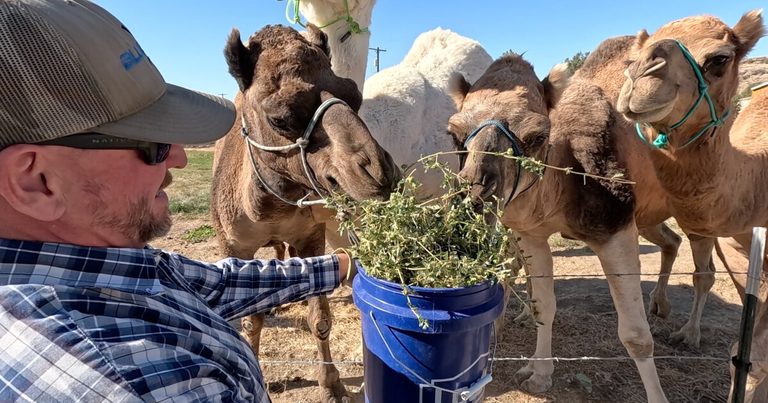
In an effort to find low‑impact ways to control invasive vegetation and reduce wildfire fuel, Thunderstorm Ranch in Kuna has put its small herd of Kuna camels to work in Canyon County. The five‑camel team, owned by Lisa Berry and her husband Darin Bell, is currently grazing on a property in Melba, where they are eating thistle, kochia, goatheads and other noxious weeds.
Local ranchers test a novel approach
“They love to eat anything you don’t want to step on – they eat thistle, they eat kochia, they eat goatheads,” Berry explained. “We happen to be the largest camel farm in Idaho, with a total of seven camels, and we’re excited to see if they can help with weed abatement and wildfire mitigation.”
The experiment began after Berry met property owner Robin Hernandez, who was looking for a way to rehabilitate a field that had become overrun with invasive plants. “Seeing the camels every day brings a lot of joy and happiness,” Hernandez said. “If the camels can help reduce weeds and lower the risk of fire spreading, this is a great solution for our community.”
How camels differ from traditional grazing animals
Goats are commonly used for brush control, but camels have a reputation for tackling tougher, spiny vegetation that other livestock avoid. Their ability to consume a wide variety of plants makes them a promising tool for land managers seeking environmentally friendly weed control.
Berry added, “We’re hoping the camels will prove their value as a weed‑abatement animal. Our goal is to clear the field quickly so the land can be restored and the fire risk reduced.” The herd is expected to finish the job in a few days before returning to their home base in Kuna.
Potential benefits for the Treasure Valley
If the trial proves successful, the camels could be deployed on other properties throughout the Treasure Valley, offering a cost‑effective, low‑maintenance alternative to mechanical removal or chemical herbicides. The approach aligns with broader regional efforts to manage invasive species and protect homes from wildfires.
Local officials and land‑management agencies have expressed interest in the project, noting that natural grazing solutions can complement existing fire‑prevention strategies without adding chemicals to the environment.
What’s next for the camel program?
Berry and Bell plan to monitor the camels’ impact closely, tracking vegetation reduction and any changes in fire‑fuel loads. They also hope to educate the public about the benefits of using camels for land stewardship.
For more information about Thunderstorm Ranch and its camel herd, visit their website.
Original reporting: KIVI Idaho News 6 Boise metro (local) — read the source article.